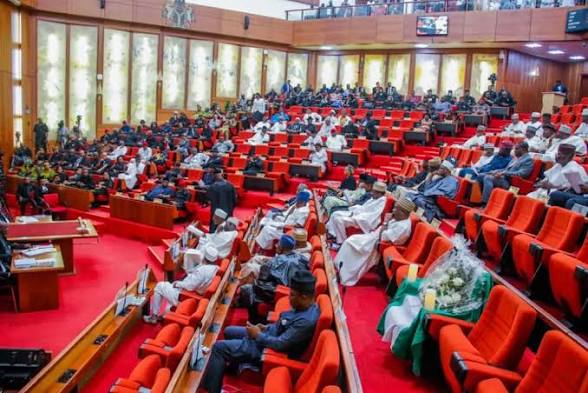
Nigeria’s fiscal trajectory took a decisive turn as the Senate approved a ₦68.32 trillion budget for the 2026 financial year, endorsing a sweeping ₦9.09 trillion upward adjustment proposed by President Bola Ahmed Tinubu.
The approved spending framework—now one of the largest in the nation’s history—lays out an ambitious mix of infrastructure investment, institutional funding, and debt obligations. A breakdown of the figures shows ₦32.29 trillion allocated to capital expenditure, ₦15.43 trillion to recurrent spending, ₦15.81 trillion to debt servicing, and ₦4.80 trillion earmarked for statutory transfers.
At the heart of the expanded fiscal plan is a clear emphasis on capital development. The ₦32.29 trillion capital component signals the administration’s intent to push forward major infrastructure projects, positioning them as engines of economic growth. Yet, the ₦15.81 trillion set aside for debt servicing underscores a parallel reality—the heavy and persistent strain of Nigeria’s debt burden on public finances.
The Senate’s approval followed its consideration of extensive revisions submitted by the President, aimed at addressing funding gaps, clearing backlogs, and accelerating priority projects. A central feature of the adjustment is the inclusion of ₦5.71 trillion in legacy capital obligations rolled over from the 2025 fiscal cycle. Alongside this is ₦2 trillion dedicated to strategic interventions across key sectors, designed to prevent project delays and sustain momentum in government programmes.
Under the Ministry of Finance Incorporated (MOFI) framework, the government is pushing forward with major rail investments. A provision of ₦478.60 billion has been set aside as equity contributions for light rail projects in Lagos, Kano, Kaduna, and Ogun States, alongside feasibility studies for additional rail lines in Enugu and Maiduguri. Another ₦8.96 billion is earmarked for studies on the Calabar–Maiduguri Corridor and the ambitious Maiduguri–Sokoto Superhighway—projects expected to deepen connectivity and unlock regional economic activity.
In the health sector, the budget reflects renewed commitments tied to bilateral agreements, with $344.83 million (approximately ₦482.76 billion) allocated to priority interventions. The judiciary also emerges as a major beneficiary, with ₦98.50 billion proposed for the Court of Appeal, ₦36.7 billion for the Supreme Court, and an additional ₦268.54 billion to enhance its overall funding envelope—partly in preparation for increased judicial demands ahead of the 2027 general elections.
Altogether, the ₦9.09 trillion adjustment represents a significant recalibration of the original fiscal framework, aligning spending with both ongoing commitments and emerging national priorities.
To fund the expanded budget, the government is banking on a combination of revenue optimisation and borrowing. A $10 increase in the oil benchmark is projected to yield ₦2.592 trillion in additional revenue, while reforms in the telecommunications sector are expected to strengthen tax inflows. Major operators such as MTN Nigeria and Airtel Nigeria are projected to contribute about ₦874 billion in corporate income tax.
Even so, a substantial portion of the financing plan hinges on external borrowing, with the government targeting ₦6.163 trillion to bridge the fiscal gap—a move that is likely to intensify debates around debt sustainability.
With its passage, the 2026 budget now stands as a central policy instrument of the Tinubu administration—aimed at driving infrastructure expansion, strengthening key institutions, and sustaining economic growth. However, its success will ultimately depend on execution discipline and the government’s ability to balance ambitious spending with fiscal prudence in an increasingly constrained economic environment.
Senate Okays ₦68.32tr 2026 Budget, Adopts ₦9.09tr Expansion in Tinubu’s Fiscal Plan