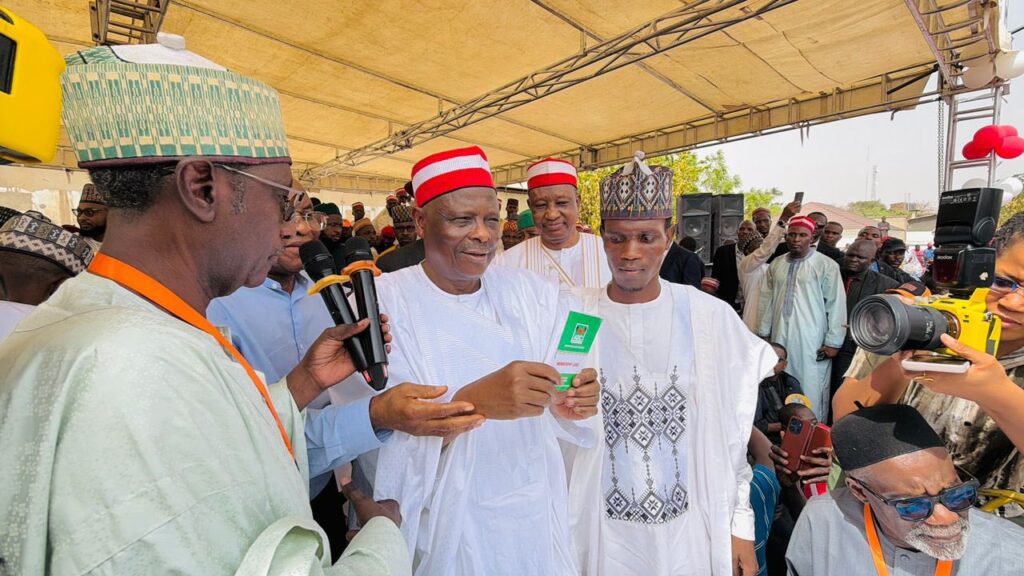
Former Kano State governor and presidential contender, Rabiu Kwankwaso, has joined the African Democratic Congress (ADC) in a move already fuelling talk of a broad opposition coalition and a possible shake-up ahead of future elections.
Kwankwaso’s formal registration in Kano on Monday came barely 24 hours after he resigned from the New Nigeria Peoples Party, a platform he helped elevate during the last electoral cycle. But beyond the symbolism of switching parties, the real story may lie in the calibre—and convergence—of political actors present at the event.
Standing alongside him were some of Nigeria’s most prominent opposition figures: ADC National Chairman and former Senate President, David Mark; former Sokoto governor, Aminu Tambuwal; ex-Minister of Transportation, Rotimi Amaechi; and Labour Party’s 2023 presidential candidate, Peter Obi.
Also in attendance were Senator Dino Melaye and former APC National Chairman, John Odigie-Oyegun—a lineup that cuts across party loyalties and ideological lines, reinforcing speculation that the ADC could be positioning itself as a rallying platform for a united opposition front.
Kwankwaso’s exit from the NNPP, announced a day earlier, was framed as a strategic decision driven by shifting political realities.
“The current trajectory of the nation’s political landscape calls for realignment,” he said, describing his resignation as difficult but necessary.
While he expressed gratitude to the NNPP leadership, including National Chairman Ajuji Ahmed, and acknowledged the loyalty of the Kwankwasiyya Movement, his next step suggests a recalibration rather than a retreat.
Analysts say the move could significantly alter the arithmetic of opposition politics, particularly if it leads to a formal alliance involving key figures already seen on the ADC platform. With multiple heavyweights now appearing under one political umbrella, the development hints at early efforts to consolidate influence and avoid the fragmentation that has historically weakened opposition bids.
For the ADC, Kwankwaso’s entry is more than a high-profile defection—it is a potential gateway to northern political structures and grassroots networks built over decades. For the broader opposition, it may represent the clearest sign yet that coalition-building is no longer theoretical, but underway.
As political alignments begin to crystallise, Kwankwaso’s move could prove to be less about party switching—and more about the opening chapter of a larger political convergence.
Kwankwaso’s ADC Move Sparks Coalition Talks, Redraws Opposition Map