By Douglas Baye-Osagie
The scales have fallen from our eyes: it’s now clear that Nigeria’s participation in the 2026 FIFA World Cup has become a fairy tale. The push to qualify through a poorly documented legal process was a badly written script by the federation, meant to keep fans hopeful and shield officials from criticism by a demanding football public during the last African Cup of Nations. It also gave federation members a quiet window to prepare for a possible re-election later in the year. *The whole episode feels less like sport and more like political stagecraft.*
The same football federation that failed to qualify for two consecutive World Cups and two Olympic tournaments seems eager to stay on for another four years. Nothing is impossible in Nigerian politics — and with an election of just about 40 voters, most of them the 36 state FA chairmen who sail in the same boat as the incumbent president, we may well see the Gusau-led board returned to run the NFF. *Accountability has become an optional extra.*
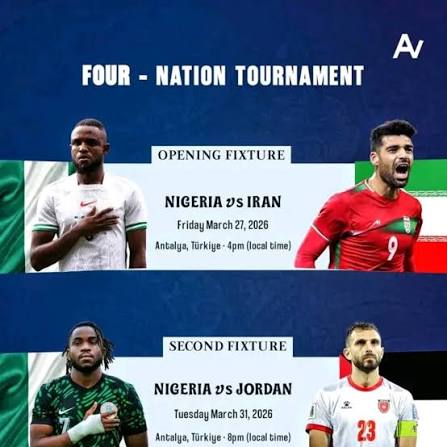
As other nations prepare for World Cup playoffs, Nigeria’s football hierarchy is leveraging the team’s decent outing at the last Nations Cup in Morocco to arrange friendlies with World Cup-bound countries. This weekend we face Iran and Jordan — two Middle Eastern teams with modest pedigrees that don’t command high stakes in world football. *They are convenient, low-risk fixtures that pay the bills.*
Nigerians aren’t asking questions about real development of the game at all levels. Fans are no different from administrators, and that’s Nigerian football’s first problem: we’ve chased tournament glory while neglecting to build a foundation for growth. *Grassroots pitches remain dusty, and academies survive on goodwill.*
Women’s AFCON preparations also need serious attention. A double-header friendly against Cameroon was worthwhile, but the April window has been left unattended. No friendlies for the Women and we are not asking questions about the preparations. The postponed WAFCON will serve as qualification for next year’s World Cup in Brazil; if we fail to make it, this board will go down as the worst in modern history. *The Super Falcons deserve more than afterthought scheduling.*
As for the Super Eagles, we shouldn’t be playing Iran or Jordan — with all due respect — if we had qualified for the World Cup. Even having missed out, we ought to have lined up a stronger European or South American opponent from among World Cup-bound sides. Zambia, who finished bottom of their AFCON group in Morocco and also missed the World Cup, will face world champions Argentina. There’s real interest in that fixture; it’s more than a friendly, it’s a rare chance to measure, learn and grow. Games like those aren’t judged by the final score alone, but by what they reveal about administration, structure, and mental preparation. If you ask me, this is an opportunity missed. The NFF seems to have prioritised appearance fees — oil money from the Middle East — over the quality of opposition. *We trade tests for cheques.*
We haven’t heard the end of the contract imbroglio with Eric Chelle. The decision to extend his deal and give him a raise hasn’t been finalised. If Chelle takes the job, any coach the federation ties down should also be ready to lead the Olympic team. Our inability to qualify for back-to-back Olympic soccer events has badly hurt competitiveness in World Cup qualifiers. I recall vividly that the U23 team’s gold-medal triumph in Atlanta ’96 made qualification for France ’98 a stroll in the park. The last time we qualified for the World Cup — Russia 2018 — we had also qualified for the Olympics in Brazil 2016. *The link between youth success and senior qualification is no coincidence.*
A cursory look at the squad called up for the friendlies shows Chelle stamping his authority. Some players who surprisingly made the AFCON final list didn’t make this one. It clearly showed that some of those players who couldn’t even get minutes were not expressly selected by the coach like most of us suspected.
Nwabali’s curious decision to terminate his contract with Chippa United has left him clubless since AFCON. That could usher in the return of Maduka Okoye, despite his turbulent Super Eagles career. Regular football in Italy is an advantage to his mental preparation. *Okoye’s club minutes might just steady his nerve at international level.*
In defence, there’s little to excite, aside from the inclusion of 6’5” Rangers centre-back Emmanuel Fernández. Born in the UK, he has earned high praise this season, and it would be gratifying to see him earn his Super Eagles baptism of fire. His displays for Glasgow Rangers have raised his stock, with top English clubs now circling. *A composed debut could solve a problem area for years.*
We have two new attackers who have been knocking on the door: Genk speedster Yira Sor and Hamburger SV winger Philip Otele. They’ll spice up any attack in Africa and, in a competitive atmosphere, should raise the team’s level. *Both offer the kind of directness that breaks low blocks.*
Old heads must treat these friendlies as preparation for next year’s AFCON. Alex Iwobi, Wilfred Ndidi and Moses Simon should use the final years of their careers to lead the next generation toward a winning mentality. The Super Eagles should be the team feared in Africa. Losing to hosts Morocco only on penalties shows we’re close; we need focus forged on grit and panache to overcome any opponent. *Leadership now matters more than ever.*
Victor Osimhen’s absence should give Paul Onuachu a chance to establish himself as a reliable centre-forward when Victor is unavailable. That was a big problem in World Cup qualifying: without Osimhen we struggled, taking just 3 points from the first 12. We roared back when he returned, but South Africa had already built a healthy lead. *Building a Plan B is not optional.*
Going forward, friendly invitations should keep an eye on Olympic qualification in 2028, building momentum for the 2030 World Cup in Morocco, Spain and Portugal. A crop of U23 players will form the nucleus in four years. The national team isn’t a permanent home, and those involved must bring their best. The Super Eagles will rise again against all odds. *If structure finally matches talent, there’s no ceiling.*