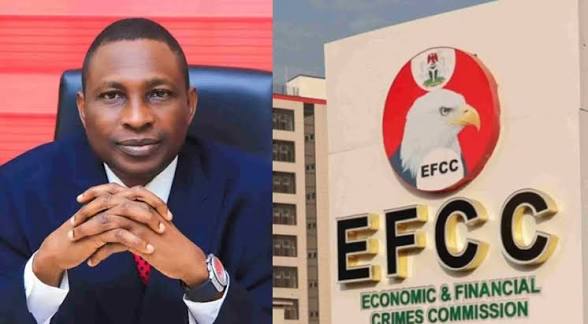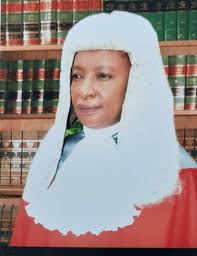
Proceedings in the ongoing Mambilla Hydropower Project trial were disrupted on Monday, March 16, 2026, following extensive renovation works at the FCT High Court chambers in Apo District. The situation forced Justice Jude Onwuegbuzie to relocate from Court 30 to Court 14 before proceedings could continue.
The trial eventually commenced at about 12:30 pm and lasted until 3:00 pm, during which the defence concluded its cross-examination of the EFCC’s star witness, Umar Babangida (PW3), setting the stage for the next phase of the high-profile case.
On the final day of his cross-examination, PW3 revealed a significant development: the Defendant reportedly saved the Federal Government nearly $900 million by structuring the May 21, 2003 Mambilla Hydroelectric Power Project as a Build, Operate, and Transfer (BOT) contract, with government equity capped at just 10 percent. This figure sharply contrasts with earlier proposals, including the 25 percent equity approved by then-President Olusegun Obasanjo and the 35 percent stake suggested by the Minister of Power who preceded Olu Agunloye, the Defendant in the case.
However, in a noteworthy move, after calculating and presenting to the court how this figure was arrived at, PW3 went on to say: “the Defendant caused the $900 million saving for Federal Government by his unilateral decision.”
During his cross-examination, PW3, Umar Babangida, sought to clarify discrepancies in the multiple versions of the “Minutes of the 21 May 2003 Federal Executive Council (FEC) Meeting” submitted as evidence. He noted that “Exhibit 3D contains Paragraphs 13, 14, and 15, while Exhibit 3K only includes Paragraph 14.” Babangida also admitted that the Defendant, in an extra-judicial statement, had advised him and other EFCC investigators to speak with surviving members of the 2003 FEC to obtain a full account of the meeting, but he did not follow this instruction, choosing instead to interview only former President Olusegun Obasanjo, who chaired the council at the time.
Further into cross-examination, PW3 conceded that another prosecution witness, Jide Sotinrin, did not inform him that payments made to the Defendant’s account in August (N3.6 million), October (N500,000), and December (N1.1 million) 2019 were gratifications from Leno Adesanya. Nevertheless, he maintained that the transfers were retroactive bribes connected to the May 2003 Mambilla contract, paid to Olu Agunloye more than 16 years after he had left public office. Babangida also revealed that the Defendant had informed him of personal health issues and his son’s need for medical surgery in 2019, yet the witness admitted he had not contacted the Defendant’s son or others who reportedly received the payments to verify these claims.
PW3 further told the court that he could not recall the enactment date of the Public Procurement Act but acknowledged, when informed, that it came into force in 2007—four years after the Mambilla contract was awarded. He also stated that he was unaware of any Ministerial Tenders Board at the time but confirmed that an Inter-Ministerial Technical Committee oversaw aspects of the project. Following the conclusion of cross-examination, the defence formally closed, and Justice Jude Onwuegbuzie adjourned the case until 12:00 pm on Monday, 30 March 2026.
EFCC witness reveals Nigeria saved nearly $1bn on Mambilla contract