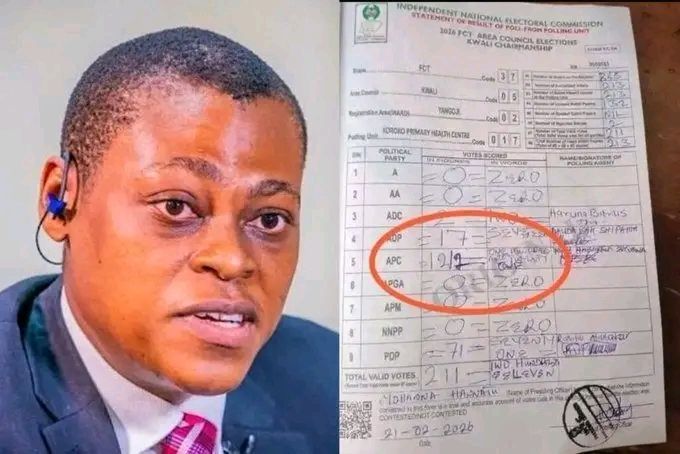
What should have been a routine local government election in Nigeria’s capital has instead spiraled into a credibility crisis, raising troubling questions about transparency, accountability, and the sanctity of the ballot.
At the heart of the controversy is the Independent National Electoral Commission (INEC), following the emergence of figures from a polling unit in the Abuja Municipal Area Council (AMAC) that appear to defy logic.
Documents from the unit reportedly show: 345 registered voters, 213 accredited voters
211 valid votes cast
Yet, in the same result sheet, the All Progressives Congress (APC) was credited with well over 1,200 votes — a number far exceeding the total accredited voters
The discrepancy was publicly flagged by broadcaster Rufai Oseni, who questioned how such results could pass through multiple layers of collation without detection.
Beyond the inflated figures, reports indicate inconsistencies between the numerical entries and the votes written in words on the official Form EC8A — deepening suspicions of error or manipulation.
The disputed results come in the wake of INEC’s declaration of Christopher Maikalangu of the APC as winner of the AMAC chairmanship election.
His closest rival, Moses Paul of the African Democratic Congress (ADC), has rejected the outcome, alleging widespread irregularities and calling for a comprehensive review.
Civil society organisations, including the Public and Private Development Centre (PPDC) and Yiaga Africa, have demanded a forensic audit of the FCT election results.
They argue that even a single confirmed case of over-voting — particularly one of such magnitude — undermines public trust and deepens voter apathy in a democracy already battling skepticism.
As of press time, INEC has yet to issue a detailed explanation addressing the specific polling unit discrepancies.
While the commission has described the elections as largely peaceful, critics insist peace without credibility is hollow.
For many observers, the issue transcends one ward or one council. It is about whether electoral processes can withstand scrutiny — and whether institutions entrusted with democracy’s guardianship can uphold the arithmetic of the ballot.
Until those questions are answered transparently, the shadow cast by Abuja’s “phantom votes” will linger — a stark reminder that in any democracy, numbers must tell the truth.
FCT’s ‘Phantom Votes’: The Polling Unit That Sparked Fresh Scrutiny of INEC