***As Tinubu Consolidates Northern Political Stronghold
By: Lamara Garba
From the moment Vice President Senator Kashim Shettima touched down at the Malam Aminu Kano International Airport, the ancient city shifted into a different rhythm. The roads from the airport were not just filled; they were alive. Traders, Market women, civil servants and artisans all abandoned their stalls and places of livelihood for a glimpse. Young men climbed rooftops and signposts. Elderly men in flowing babbar riga stood shoulder to shoulder with restless students waving party flags. The chants rolled like thunder across the airport Road, Fagge quarters, Murtala Mohammed Way and curved through the arteries leading to the ancient heart of the city.
It was not the choreography of hired enthusiasm. It was organic, loud, and unmistakable.
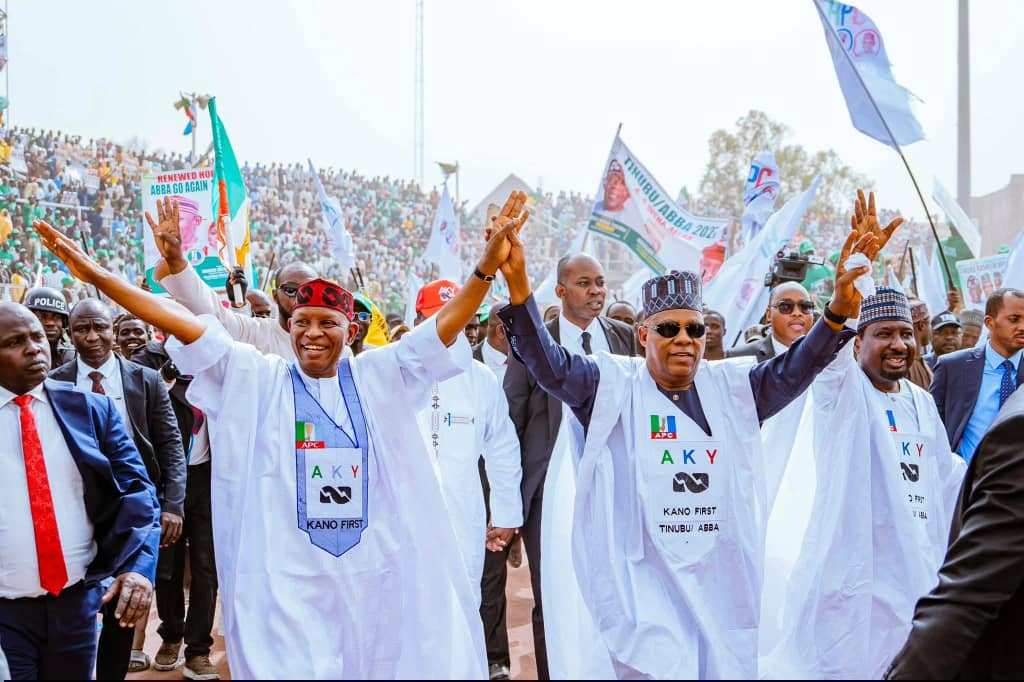
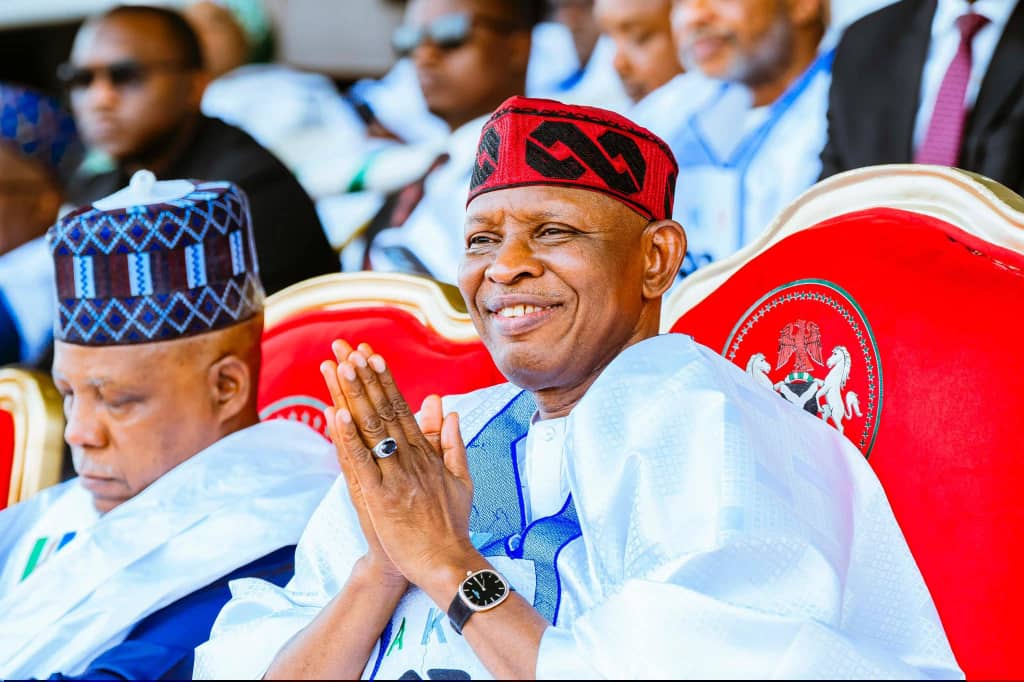
By the time the convoy approached the iconic Sani Abacha Stadium, the streets had become a river of humanity. The stadium itself seemed too small for the emotion that poured into it. In that moment, one truth stood firm: this was not a routine political reception. It was a public declaration of belonging. That Governor Abba Kabir Yusuf belongs to the people of Kano and so also the people belongs to him.

The official receiving of Governor Abba Kabir Yusuf by the national leadership of the All Progressives Congress was framed as a homecoming. But it felt like something deeper, something almost philosophical. Politics, at its highest form, is about alignment of interests, of vision, of destiny. On that day, Kano appeared to say that its destiny must sit at the table where national decisions are shaped.
Representing President Bola Ahmed Tinubu, Vice President Shettima stood before the sea of supporters and spoke with deliberate clarity. Kano, he said, is too strategic to stand at the margins of Nigeria’s future. In his tone was both political calculation and historical awareness. Kano has always been more than a state; it is a compass. When Kano moves, Nigeria feels it. When Kano speaks, the federation listens.
His words were not empty pleasantries. They were an affirmation that Governor Yusuf’s entrance into the APC was not a mere addition of a member but the strengthening of a pillar. He described the governor’s role within the party as crucial, linking Kano’s economic vibrancy and political consciousness to the broader national development agenda. It was as if the vice president was saying: a house this large must have all its strongest beams intact.
Then came the chairman of the Progressive Governors’ Forum, Hope Uzodinma, who spoke with a mix of warmth and strategy. He described Yusuf’s defection as a return home. In politics, the language of homecoming is powerful. It softens rivalry and buries past tensions beneath a narrative of reunion. Uzodinma went further, calling Kano the brain of Nigerian politics. It was a metaphor that resonated deeply with the crowd. A brain directs, calculates, interprets. By that logic, Kano’s alignment with the APC signals direction for the country.
The party’s national chairman, Nentawe Yilwatda, framed the moment as an infusion of fresh momentum. He spoke of progressive ideals and the shared responsibility to deliver development. His message was clear: this was not about numbers; it was about energy. The governor’s entry, he implied, would not dilute the party’s character but enrich it.
And then, standing like an elder statesman observing the unfolding of history, former national chairman Abdullahi Umar Ganduje declared the party in Kano stronger and more united than ever. In Kano’s political theatre, unity is currency. His words suggested that previous fractures had now been stitched into a single fabric.
But beyond the speeches of national figures was the quiet, powerful statement made by the crowd itself. No script can manufacture that level of enthusiasm. The thousands who lined the streets and filled the stadium were not there merely to witness a political transaction. They came to affirm their governor. Their presence was a reminder that leadership, in the end, is validated by followership.
Governor Yusuf, for his part, balanced gratitude with principle. He pledged that his new political alignment would not compromise his pursuit of fairness and justice. It was an important assurance. Defections often invite suspicion. But he positioned his decision as pragmatic rather than opportunistic. In his telling, joining the APC was not about abandoning ideals but about creating wider channels through which those ideals could be realized.
There was also symbolism in the federal support earlier announced for Kano’s recovery from recent challenges. The financial backing from the federal government and the governors’ forum was presented not simply as relief but as evidence of partnership. In politics, resources follow relationships. By stepping into the APC fold, Kano was not just changing party colours; it was strengthening its access to the levers of federal influence.
What unfolded at the stadium was therefore layered. On the surface, it was a mega rally filled with music, banners, and applause. Beneath that surface, it was a recalibration of political equations ahead of 2027. Kano is a state whose electoral weight can tilt national outcomes. Any party that secures Kano secures more than votes; it secures narrative dominance in the North.
Philosophically, the event underscored a timeless truth about power: it abhors isolation. In a federal system as complex as Nigeria’s, alignment between state and centre often determines the speed of development. The rally conveyed a shared understanding that Kano’s ambitions are best pursued in concert with the ruling party at the national level.
Idioms floated effortlessly through the speeches and the chants. A tree does not make a forest, but a mighty tree can anchor it. A river that finds the ocean does not lose itself; it becomes part of something vast. These were the unspoken metaphors of the day. Governor Yusuf’s political journey had curved, and now it had merged.
Yet the most striking element remained the people. They turned the reception into a festival of affirmation. They transformed a party event into a civic spectacle. They demonstrated that politics in Kano is not passive; it is participatory, emotional, almost theatrical.
In the end, the mega rally was more than a formal welcome. It was a declaration that the APC considers itself fortunate to have Governor Yusuf within its ranks, and that Kano believes its voice will echo louder from within the corridors of federal power. It was a moment where strategy met sentiment, where calculation met conviction.
And as the sun dipped over the ancient city and the crowds slowly dispersed, one could sense that something had shifted. Kano had spoken, not in whispers but in waves. Whether history will judge the decision kindly remains for the future. But on that Monday in February, the message was unmistakable: the political map of Kano had been redrawn, and the ink was still fresh.
Lamara Garba a veteran journalist writes from Kano