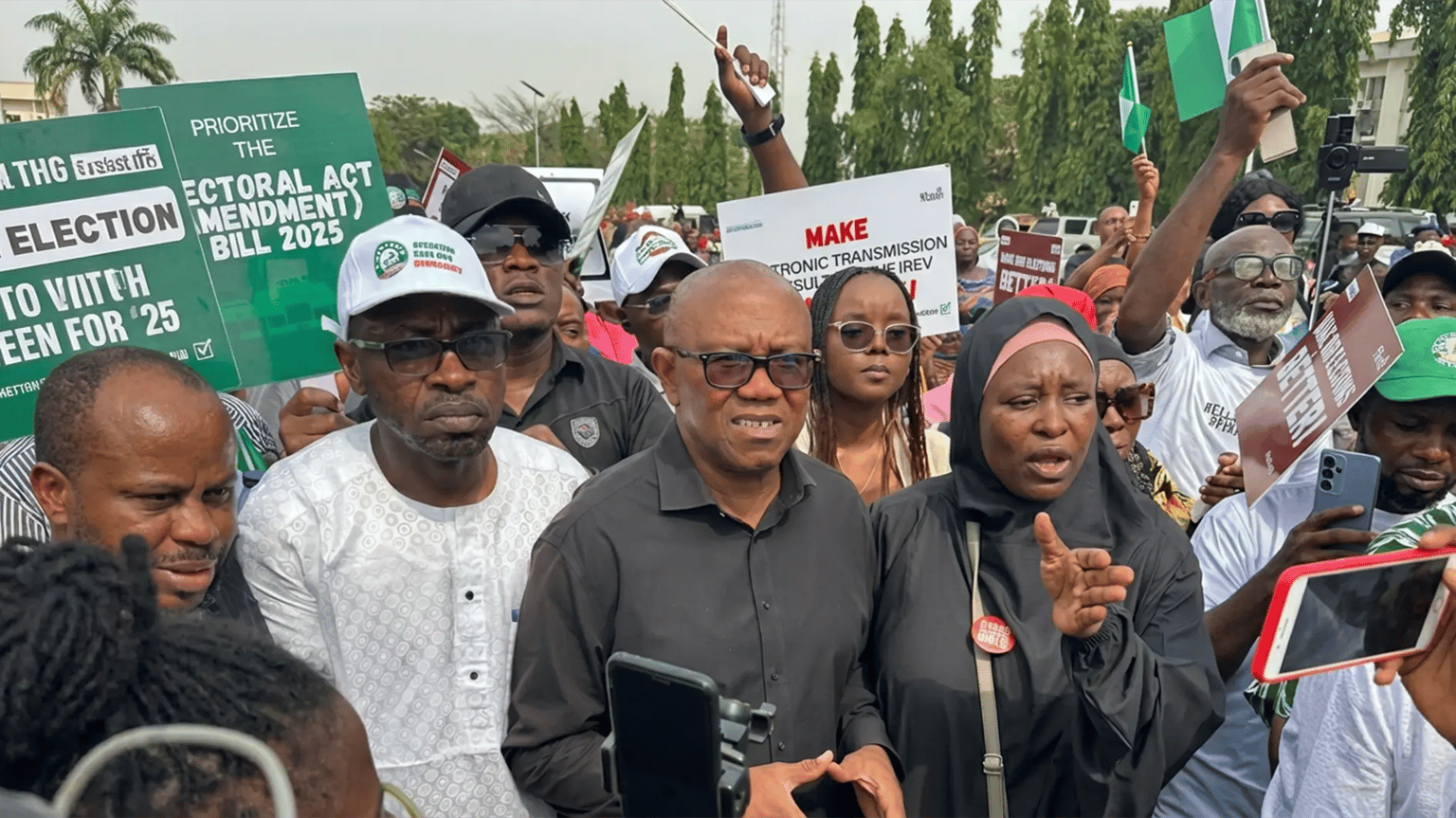
Former presidential candidate of the Labour Party, Mr. Peter Obi, on Monday took the battle for credible elections directly to the gates of the National Assembly, joining hundreds of protesters in a dramatic show of defiance against what demonstrators described as a renewed attempt to rig the 2027 general elections through legislative manoeuvring.
The protest, branded “Occupy the National Assembly,” was triggered by the Senate’s controversial decision to delete the phrase “real-time” from provisions on electronic transmission of election results in the Electoral Act Amendment Bill. Critics insist the move significantly weakens safeguards against post-election manipulation and undermines public confidence in the electoral process.
Obi’s sudden appearance electrified the crowd as demonstrators — drawn largely from the Obidient Movement, civil society organisations and pro-democracy groups — besieged the National Assembly complex, chanting protest songs and brandishing placards reading “Our Votes Must Count,” “No to Electoral Robbery,” and “Protect Democracy Now.”
The protest marked one of the most visible confrontations yet between advocates of electoral reform and lawmakers over preparations for the 2027 polls.
Security operatives from the Nigeria Police Force, the Nigerian Army and the Nigeria Security and Civil Defence Corps mounted a heavy barricade around the complex, preventing protesters from gaining access into the National Assembly and forcing them to stage the demonstration outside the main gates under tight surveillance.
Addressing journalists amid the charged atmosphere, Obi warned that Nigeria was sliding dangerously backwards, accusing the political elite of nurturing what he described as “electoral criminality” capable of destabilising the country.
“We must dismantle this criminality and prove that Nigeria can still show light in Africa,” Obi said. “Credible elections are the foundation of development, unity and peace. Once you undermine elections, you undermine the nation itself.”
Last week, the Senate passed the Electoral Act 2022 (Repeal and Re-enactment) Amendment Bill, 2026, but controversy erupted after it emerged that the words “real-time electronic transmission” were removed from key clauses relating to the transmission of election results.
Although the Senate later insisted that it did not scrap electronic transmission entirely, protesters argue that removing the requirement for real-time transmission creates dangerous ambiguity, leaving room for manipulation during result collation and announcement.
For many protesters, Obi’s presence reinforced his image as a central figure in Nigeria’s youth-driven political awakening that disrupted the traditional political order during the 2023 elections. Supporters say his decision to join the protest reflects a broader struggle to protect the gains recorded through technology-driven electoral reforms.
The National Coordinator of the Obidient Movement Worldwide, Dr. Yunusa Tanko, vowed that protests would continue until the National Assembly explicitly restores real-time electronic transmission of results in the law.
“If there is no electronic transmission of results, there will be no election,” Tanko warned. “Our elections must be credible, transparent and verifiable by the people.”
Tanko recalled that Nigeria’s electoral history has been plagued by manual interference, ballot stuffing and result alteration, flaws electoral technology was designed to eliminate following reforms after the deeply flawed 2007 general elections.
While innovations such as card readers in 2015 and the introduction of the Bimodal Voter Accreditation System (BVAS) in 2022 improved transparency and voter accreditation, activists insist that real-time result transmission remains the missing link in securing the integrity of elections.
Popular activist Randy Peters also accused the political class of betraying democratic ideals, invoking the spirit of the June 12, 1993 election, widely regarded as Nigeria’s freest and fairest.
“Do we have democrats who are afraid of losing elections?” Peters asked. “In 2027, our votes must count. Tomorrow, we will be back here.”
Earlier, tension had enveloped the National Assembly as protesters massed at the entrance under tight security, following a call to action by human rights activist and former presidential candidate, Omoyele Sowore, who urged Nigerians to resist what he described as a calculated attempt to compromise future elections.
As of the time of filing this report, security remained tight around the National Assembly, while protesters vowed to sustain pressure until the demand for clear, unambiguous real-time electronic transmission of election results is firmly enshrined in law.
Obi leads Protesters to Demand Real-Time Transmission of Results at NASS