The Senate’s passage of the Informal Sector Employment (Regulation) Bill, 2025, has brought about a turning point for domestic workers in Nigeria, as civil society groups and women journalists call for its swift enforcement and the establishment of unions to safeguard their rights.
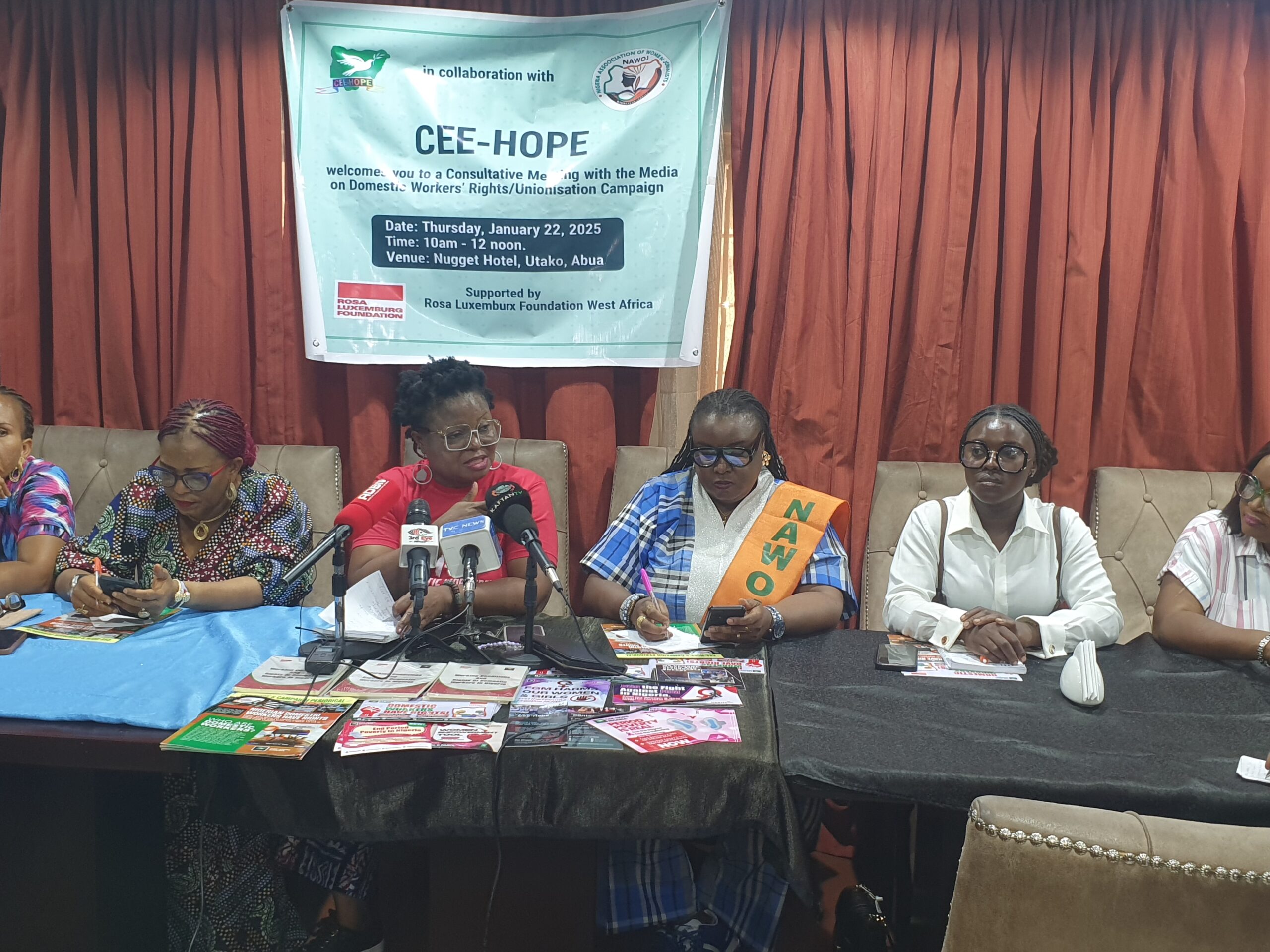
During a media consultative meeting in Abuja on Thursday, CEE-HOPE and the Nigeria Association of Women Journalists (NAWOJ) hailed the bill as the strongest legal framework to date for protecting domestic workers, apprentices, and interns from abuse, exploitation, and unfair labour practices nationwide.
The legislation, sponsored by Senator Diket Plang (Plateau Central), seeks to formalise domestic work, regulate recruitment agencies, and introduce accountability into Nigeria’s largely unregulated informal labour sector. Lawmakers say it became necessary amid rising cases of sexual violence, forced labour, torture, and non-payment of wages involving domestic workers.
Executive Director of CEE-HOPE, Betty Abbah, described the Senate’s action as a critical breakthrough, noting that the absence of legal structure has left domestic workers isolated and vulnerable.
She said the bill could finally pave the way for domestic workers’ unions, which would provide collective bargaining power, legal support, and early intervention mechanisms to prevent abuse. Abbah recalled several fatal abuse cases, including that of Joy, a domestic worker from Benue State who was killed during the COVID-19 lockdown, stressing that such incidents thrive in legal and institutional gaps.
Despite Nigeria’s large domestic worker population, the country still lacks a functional union for the sector, unlike Ghana, Kenya, and South Africa, where domestic workers are protected through unionisation and national labour laws aligned with International Labour Organisation Convention 189.
Also speaking, NAWOJ Vice President (Zone D), Chizoba Ogbeche, said the bill’s passage presents an opportunity to confront entrenched societal attitudes that normalise abuse, particularly of underage girls employed in homes.
She stressed that presidential assent and strict enforcement will determine whether the legislation translates into real protection, warning that laws without implementation risk becoming symbolic.
Ogbeche also criticised the practice of paying domestic workers through recruitment agencies rather than directly, describing it as a form of modern-day exploitation that the new law must address.
As the bill awaits presidential assent, CSOs say the focus must now shift from advocacy to implementation, urging the Federal Government to move quickly in setting up regulatory structures that will give domestic workers visibility, voice, and protection under the law.
For campaigners, the message is clear: the passage of the bill is not the end of the struggle, but the beginning of accountability.
CEE-HOPE, NAWOJ Optimistic Informal Sector Bill Will Transform Domestic Work