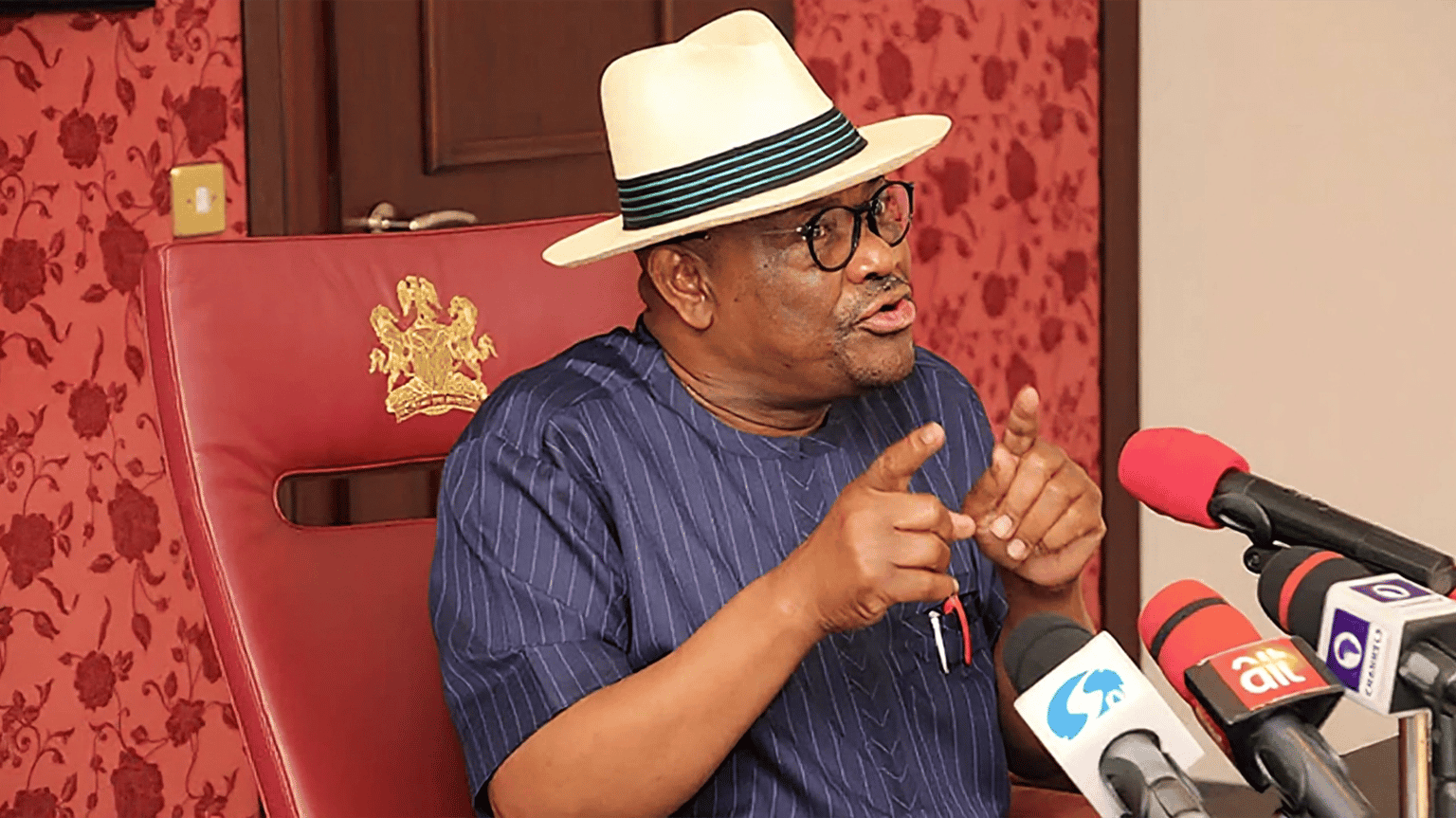
The Peoples Democratic Party (PDP) has launched a fresh broadside against the Minister of the Federal Capital Territory, Nyesom Wike, accusing him of deliberately destabilising the party while covertly advancing personal political interests under the guise of party membership.
Reacting to Wike’s recent media chat, the PDP said the minister’s open declaration of support for President Bola Tinubu confirmed what it described as long-standing suspicions that he has been working against the party from within. In a statement signed by its National Publicity Secretary, Ini Ememobong, the party characterised Wike as a “constant provocateur” whose political strategy thrives on disruption rather than principle.
According to the PDP, Wike’s claim to being the leading supporter of the ruling APC’s presumed 2027 presidential candidate represents a clear breach of party discipline and democratic norms. The party said such conduct strips away any remaining ambiguity about where his loyalties lie.
The statement traced what it described as a consistent pattern of internal sabotage, recalling Wike’s role during multiple leadership crises in the PDP. From the Ali Modu Sheriff era to his shifting positions on former national chairman Uche Secondus, and later his support for—and subsequent opposition to—Iyorchia Ayu, the PDP argued that Wike has repeatedly used conflict as a political weapon.
“These are not ideological disagreements,” the party said, “but calculated disruptions aimed at advancing narrow personal ambitions.”
At the state level, the PDP accused Wike of entrenching divisions during his tenure as Rivers State governor between 2015 and 2023. It cited allegations of candidate imposition, exclusionary practices and the restriction of PDP presidential campaign activities in Rivers State during the 2023 elections as actions that weakened internal democracy.
The party further argued that Wike’s continued insistence on remaining a PDP member—despite serving in an APC-led federal government—deepened internal fractures and blurred political accountability. His recent statements, it said, now make it clear that he and his associates have chosen to openly align with the APC against the PDP.
“Now that the mask is off,” the party declared, “Nigerians can clearly see an attempt to trade the destruction of the PDP for personal political bargains.”
The PDP also warned that any agreements reached for what it described as “illegal purposes” cannot stand, reminding Wike—whom it noted is a lawyer—that such arrangements are unenforceable under the law.
Looking ahead, the party said it is focused on rebuilding its internal structures and resolving ongoing legal disputes under the Kabiru Turaki-led National Working Committee. It reaffirmed its commitment to presenting a credible presidential candidate ahead of the 2027 elections, stressing that party renewal would not be derailed by individual ambitions.
As political alignments ahead of 2027 continue to shift, the PDP’s intervention signals a hardening stance: what it once treated as internal dissent is now being framed as outright political betrayal.
PDP Accuses Wike of Playing Double Game, Says Loyalty Has Finally Unravelled