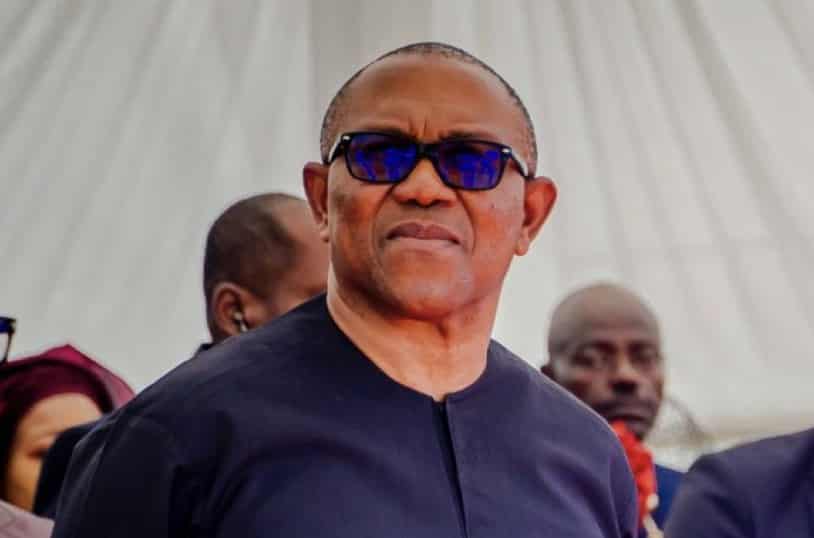
Peter Obi has confirmed he will contest Nigeria’s 2027 presidential election, but in a manner that defies the usual bravado of early campaign declarations. Rather than trumpet inevitability or victory, the former Anambra State governor chose restraint—tempering ambition with humility and an appeal to national conscience.
“Yes, I will be on the ballot in 2027,” Obi said during an extended conversation on X (formerly Twitter) Spaces. “But I am not God. Tomorrow is not guaranteed.”
That remark shaped a reflective, wide-ranging dialogue in which Obi presented his aspiration not as a personal quest for power, but as a continuation of what he described as a lifelong commitment to building a country that works for its citizens. Again and again, he returned to the idea that Nigeria’s greatest challenge is not politics, but values.
Obi was emphatic that desperation has no place in his politics. He urged supporters to resist insults, intimidation and political hostility, insisting that such conduct only deepens the fractures threatening national cohesion.
“I am not desperate to be president,” he said. “I am desperate to see Nigeria work.”
Personal attacks, he added, no longer disturb him. What troubles him deeply is the erosion of security and confidence across the country. He lamented that Nigerians can no longer travel freely, recalling a time when inter-regional movement was routine, trade fairs thrived nationwide, and hotels were booked years in advance.
Anchoring his credibility in his public record, Obi challenged critics to point to any instance of personal enrichment while he held office. He recalled leaving behind $150 million in savings for Anambra State, arguing that leadership should be judged by verifiable outcomes rather than slogans.
“I didn’t leave one million dollars. I left 150 million dollars,” he said, adding that the value of those funds today would be even more instructive.
Obi reinforced this narrative with examples of personal restraint. As governor, he said, he declined luxury vehicles, opting instead to channel resources into institutions and public servants. For four years, he drove a Peugeot 406 while ensuring judges, magistrates and senior civil servants—some previously commuting by motorcycle—were provided official vehicles.
“These things are not pretence,” he said. “This is how I live.”
He also recalled reallocating land originally assigned to him to a retiring civil servant who had spent 35 years in service without owning a home, describing the gesture as emblematic of the kind of leadership Nigeria urgently needs.
Coalitions, but not at any cost
On emerging opposition alliances ahead of 2027, Obi drew a clear line. While open to collaboration, he said he would only participate in coalitions driven by public interest rather than personal ambition.
“I will only be part of a coalition that is committed to forming a government that will serve the people and change the narrative of Nigeria,” he said, adding that he had prayed not to be drawn into arrangements built solely around power.
He rejected politics rooted in ethnicity or religion, insisting that competence and character must define leadership. Any coalition that fails this test, he warned, would not earn his participation.
“If a coalition is not for the people, I will not be part of it.”
Responding to allegations of ethnic or religious bias, Obi cited his record of cross-regional engagement. All his commissioners of police as Anambra governor, he noted, were from Northern states, while his professional teams over the years cut across the federation. His aide-de-camp was from Kano, and his wife is from Akwa Ibom.
“Poverty and insecurity do not know tribe or religion,” he said, arguing that those who promote division do so out of fear of national unity.
Economy, taxes and productivity
On economic policy, Obi reiterated his opposition to taxation that ignores widespread hardship and low productivity.
“We cannot tax poverty,” he said. “Tax is a function of productivity. You cannot withdraw from an account where nothing was deposited.”
With more than 130 million Nigerians living in poverty and millions of young people unemployed, he argued that job creation and economic expansion must come before aggressive revenue drives.
He also clarified controversies surrounding past elections, noting that endorsing a candidate does not amount to managing their campaign. By contrast, he said his own presidential campaign involved extensive nationwide engagement and personal oversight.
“When it is my campaign, I do it my way,” he said.
Addressing allegations of tribalism during his tenure as governor, Obi dismissed claims that any group was ever asked to leave Anambra State under his administration, describing them as unfounded.
Humility over hubris
Despite confirming his 2027 bid, Obi repeatedly returned to the theme of uncertainty and restraint. Political ambition, he stressed, must remain subordinate to moral responsibility.
“I am not God. Tomorrow is not guaranteed,” he said again.
He appealed for prayers, discipline and constructive engagement rather than abuse or confrontation, warning that arrogance and aggression are often mistaken for strength in Nigerian politics.
“Nigerians must stop celebrating bad behaviour as leadership,” Obi said. “What we need is competence, compassion, commitment and character.”
As the contours of the 2027 race slowly emerge, Obi’s intervention stands out not for claims of inevitability, but for its insistence that Nigeria’s future will be shaped less by who runs for office and more by whether the nation chooses unity, ethical leadership and hard work over division and hostility.
2027: Obi Enters the Race, Frames Ambition as Duty to a Troubled Nation