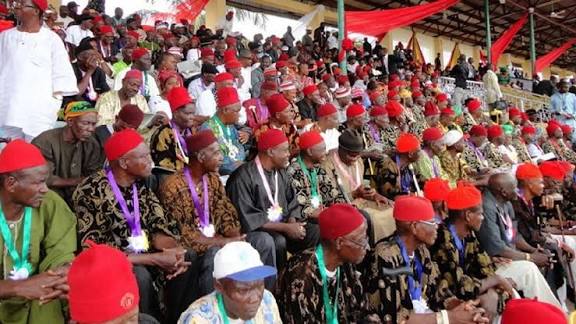
United States–based Igbo organisations have pushed back strongly against recent comments by the Minister of Works, Senator David Umahi, insisting that the administration of President Bola Tinubu has yet to address the deep-rooted marginalisation of the South-East.
In a joint statement issued on Saturday, the groups described Umahi’s claim that the Federal Government has resolved Igbo grievances as misleading and disconnected from the lived realities of the people of the region.
The statement, signed by Dr Sylvester Onyia, President of the American Veterans of Igbo Descent; Ben Nwankwo of Ambassadors for Self-Determination; and Maxwell Dede of The Rising Sun, said the minister lacks the mandate to speak on behalf of Ndigbo.
“Senator David Umahi does not speak for the Igbo people,” the groups said. “His personal political choices should not be presented as the collective position of Ndigbo.”
They accused the former Ebonyi State governor of attempting to downplay long-standing grievances in the South-East in order to align with political interests in Abuja, warning that such narratives risk deepening mistrust between the region and the Federal Government.
According to the groups, claims that Igbo marginalisation has ended are contradicted by persistent structural and infrastructural deficits in the South-East.
“It is insulting to suggest that marginalisation is over,” the statement said. “If the problem has truly been solved, what concrete benefits has Alaigbo received since President Tinubu assumed office?”
They cited the continued neglect of critical infrastructure, pointing to the abandoned Umuahia–Enugu railway line, while rail projects in other regions remain operational.
“Why is the Umuahia–Enugu rail line still dormant when routes such as Lagos–Kano and Katsina–Niger Republic are functioning?” they asked.
The groups also questioned the region’s representation at the federal level, noting that the South-East has only five ministers, two of them junior ministers, compared with what they described as disproportionate representation enjoyed by other regions.
Beyond rail infrastructure, the organisations lamented the absence of a functional seaport and cargo airport in the South-East, despite the region’s central role in trade and commerce.
“There is no seaport in the South-East, even though our people are among the highest importers in the country,” the statement said. “There is also no functional cargo airport or major federal industrial project in the region.”
On the continued detention of Mazi Nnamdi Kanu, leader of the Indigenous People of Biafra (IPOB), the groups described his incarceration as a glaring symbol of injustice against the Igbo people.
“Why is Mazi Nnamdi Kanu in detention while known terrorists and mass murderers roam free or are treated with leniency?” they asked, arguing that his continued detention fuels anger and a sense of betrayal among many Igbos.
They also criticised the Ebube Agu regional security outfit, accusing those who established it of enabling abuses in parts of the South-East and demanding accountability for alleged atrocities often blamed on IPOB and the Eastern Security Network (ESN).
Reaffirming their position, the groups stressed that the agitation for Biafra transcends individual politicians and political appointments.
“The struggle is not about pleasing Abuja or securing appointments,” they said. “It is about justice, dignity and self-respect.”
They concluded by reiterating their rejection of Umahi’s claims and issuing a clear demand to the Federal Government.
“David Umahi does not speak for Ndi Igbo. He speaks only for himself,” the statement declared. “Our position remains unchanged: release Mazi Nnamdi Kanu. Anything else amounts to deception.”
US-Based Igbo Groups Tackle Umahi, Say Tinubu Hasn’t Ended Marginalisation