**(Unveils Hardline Security Doctrine,
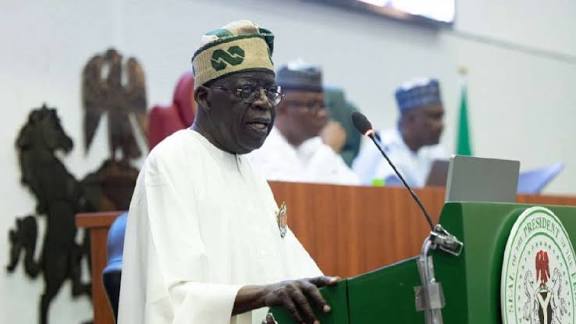
President Bola Ahmed Tinubu on Friday combined a sweeping security declaration with an ambitious fiscal roadmap as he laid before the National Assembly a ₦58.18 trillion 2026 Appropriation Bill, formally classifying all armed non-state actors operating outside government authority as terrorists.
Presenting the budget to a joint sitting of the Senate and House of Representatives, Tinubu said the 2026 fiscal plan marks a decisive transition from economic stabilisation to consolidation, delivery and shared prosperity, following two and a half years of painful but necessary reforms.
Tagged the “Budget of Consolidation, Renewed Resilience and Shared Prosperity,” the proposal seeks to entrench macroeconomic stability, expand capital investment and reset Nigeria’s national security architecture in response to persistent threats from banditry, terrorism and organised criminal violence.
In one of the most forceful moments of the address, the President declared that bandits, militias, kidnappers, armed gangs, cult groups, forest-based armed collectives and foreign mercenaries would henceforth be treated as terrorists under a new counterterrorism doctrine. He extended the designation to financiers, ransom negotiators, arms suppliers, informants, transporters and political, traditional or religious figures found to be aiding violent groups.
“The test is simple,” Tinubu told lawmakers. “If you wield lethal weapons and operate outside the authority of the Nigerian state, you are a terrorist.”
He said the administration is rolling out a redesigned national security framework anchored on unified command, intelligence-driven operations, community stabilisation and criminal justice reforms, backed by a ₦5.41 trillion allocation to defence and security in the 2026 budget.
Beyond security, Tinubu painted an optimistic picture of an economy emerging from turbulence. He cited data showing GDP growth of 3.98 per cent in the third quarter of 2025, moderation in inflation for eight consecutive months, and a sharp rise in external reserves to about $47 billion — the highest level in seven years.
“These results did not happen by chance,” the President said. “They are the outcome of deliberate, difficult choices. Our duty now is to consolidate them so that stability translates into prosperity that is shared by all Nigerians.”
The proposed budget projects ₦34.33 trillion in total revenue against ₦58.18 trillion in expenditure, with a deficit of ₦23.85 trillion, equivalent to 4.28 per cent of GDP. Tinubu defended the deficit as necessary to sustain capital-led growth, stressing that borrowing would remain disciplined and tied to projects with measurable public value.
Capital expenditure takes centre stage in the proposal, with ₦26.08 trillion earmarked for infrastructure and productive investments, while recurrent non-debt spending stands at ₦15.25 trillion. Debt servicing is projected at ₦15.52 trillion, underscoring the lingering weight of past borrowing on public finances.
The budget assumptions are built around a $64.85 per barrel oil benchmark, daily production of 1.84 million barrels, and an exchange rate of ₦1,400 to the dollar.
Tinubu warned ministries, departments, agencies and government-owned enterprises that inefficiency and revenue leakages would no longer be tolerated. He announced full digitisation of government revenue collection and monitoring, with performance targets tied directly to leadership evaluations.
Education and health also feature prominently, with ₦3.52 trillion allocated to education and ₦2.48 trillion to health. The President highlighted the Nigerian Education Loan Fund, which he said has already supported more than 418,000 students nationwide, and disclosed that healthcare spending now accounts for about six per cent of the total budget, excluding liabilities. He also announced over $500 million in US grant support for health interventions.
Infrastructure received ₦3.56 trillion, spanning transport, energy, ports and agriculture. Tinubu described food security as a core national security issue, pledging fresh investments in mechanisation, irrigation, storage and agro-processing to stabilise food supply and rural incomes.
While acknowledging the hardship imposed by reforms, the President assured Nigerians that 2026 would be a year of visible results.
“The most important budget is not the one we present,” Tinubu said. “It is the one we implement.”
He concluded by urging sustained cooperation between the Executive and Legislature, saying national unity and institutional collaboration were indispensable to delivering the Renewed Hope Agenda and building a more secure, competitive and equitable Nigeria.