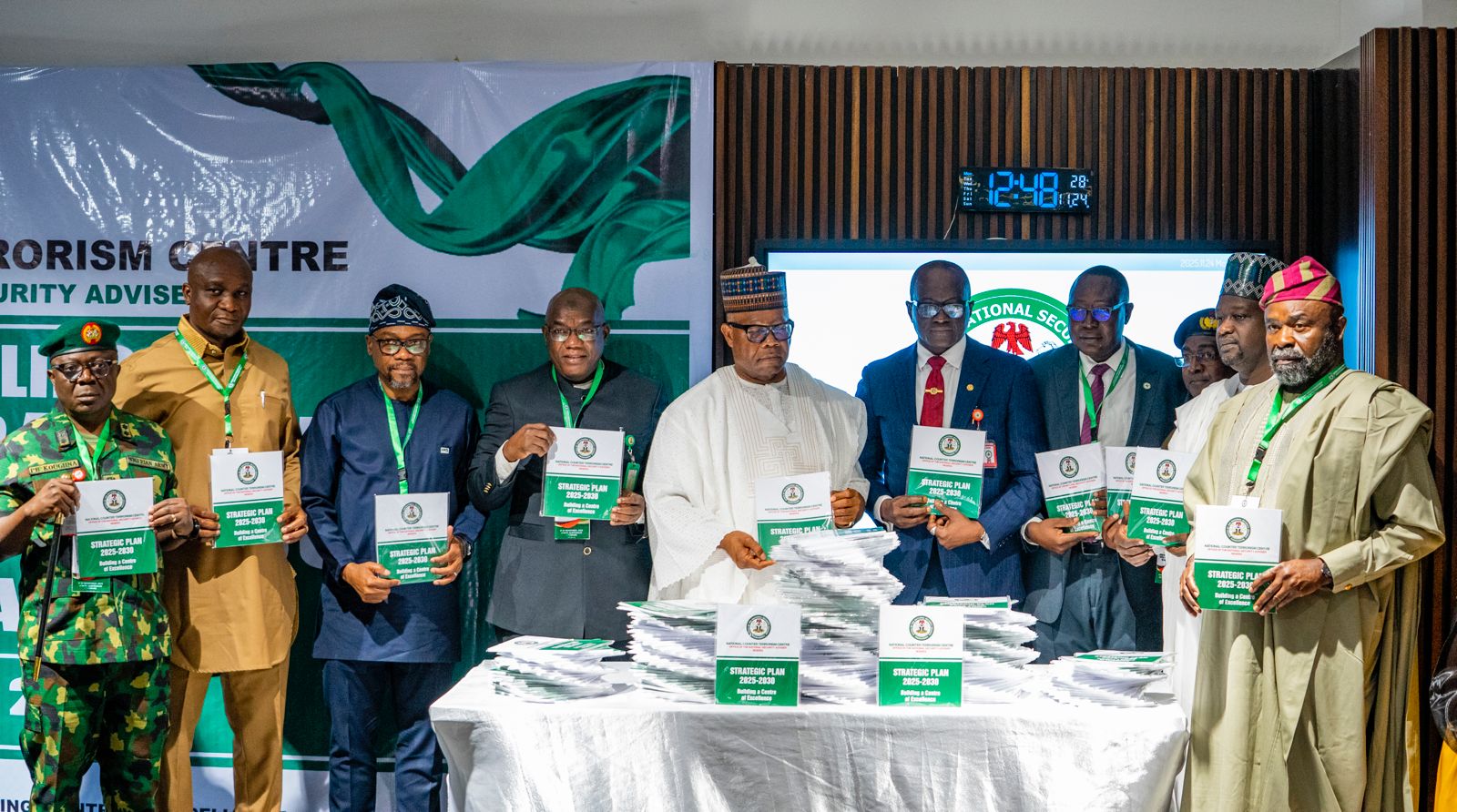
Nigeria on Monday signaled a decisive break from its long-standing reactive approach to insecurity as Senate President Godswill Akpabio launched the Counter Terrorism Strategic Plan 2025–2030, describing it as a transformational blueprint designed to “rewire” the country’s security architecture for the future.
Developed by the National Counter Terrorism Centre (NCTC) under the Office of the National Security Adviser, the new strategy marks a shift toward an intelligence-driven, technology-enabled and prevention-focused model — one that prioritizes coordination, early detection, and long-term resilience over the traditional dependence on military force.
Akpabio said the unveiling represented “a renewed national commitment” to building a country where citizens can live without fear.
“Our children deserve a future of peace,” he said. “This plan is about protecting the foundations of that future.”
He warned that terrorism is no longer just a security problem but a deep governance and development challenge. According to him, Nigeria must now invest in the systems, skills and partnerships required for early warning, rapid response and sustainable peace.
The new plan seeks to institutionalize inter-agency coherence, accountability, community engagement, and digital intelligence capabilities — areas long identified as weak points in Nigeria’s security framework.
Akpabio acknowledged the heavy toll of insecurity on the nation: declining investments, abandoned farms, displaced populations, closed schools and shrinking economic confidence. He stressed that national security cannot rest solely on the shoulders of law-enforcement agencies, noting that the National Assembly has strengthened legal frameworks to support modern policing, intelligence coordination and cybersecurity operations.
But he maintained that legal reforms must be matched with sustained investment in technology, training and institutional capacity:
“Laws alone cannot secure a nation. Implementation must be backed by resources.”
A cornerstone of the strategy is its Whole-of-Government, Whole-of-Society approach, which recognizes that the fight against terrorism requires cooperation between government, communities, traditional institutions, the private sector and international partners. The plan aligns with global counter-terrorism models that emphasize prevention, deradicalization, digital monitoring, financial tracking and cross-border collaboration.
National Security Adviser Nuhu Ribadu, represented by Major General Adamu Laka, said the document consolidates years of research, inter-agency engagement and consultations with international partners. He added that it positions the NCTC to evolve into a regional hub of excellence for countering violent extremism across West Africa and the Sahel — regions still threatened by rapidly evolving terror networks.
The launch comes as Nigeria faces a complex mix of hybrid threats, including terrorism, banditry, cyber-radicalization, arms trafficking and shifting global security pressures. Analysts say the country can no longer afford short-term or reactionary responses.
With its measurable five-year benchmarks and emphasis on long-term planning, the strategic plan signals Nigeria’s readiness to transition from crisis-driven firefighting to a sustained, forward-looking security model — and to restore public confidence in the state’s capacity to protect its people.
Akpabio Unveils Bold Counter-Terrorism Blueprint, Calls for National Security Reset