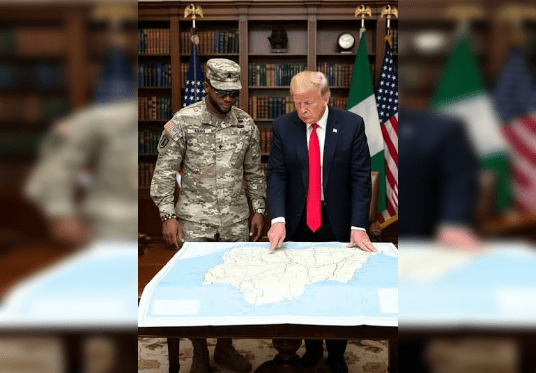
The Pentagon has received contingency plans for potential air operations in Nigeria — from intelligence support to carrier-based strikes — after U.S. President Donald Trump ordered the Defense Department to “prepare to intervene” to protect Christians there, The New York Times reports.
The options, provided by U.S. Africa Command at the request of Defense officials, outline three levels of involvement — “light,” “medium” and “heavy” — each spelling out progressively deeper U.S. military action on Nigerian soil and in the surrounding region.
Under the most robust “heavy” option, planners describe deploying a carrier strike group to the Gulf of Guinea and using fighter jets or long-range bombers to strike militant positions deep inside northern Nigeria. Other proposals reportedly include targeted strikes by MQ-9 Reaper and MQ-1 Predator drones against insurgent camps, convoys and vehicles, guided by U.S. intelligence.
By contrast, the “light” option focuses on ramping up intelligence sharing, logistics, and joint operations with Nigerian forces — measures designed to aid, rather than supplant, local security efforts.
Pentagon officials cautioned that limited strikes alone are unlikely to end Nigeria’s long-running insurgency without a sustained, large-scale campaign — the kind of commitment Washington fought in Iraq and Afghanistan — a course they say the U.S. is not pursuing now. The flashpoint for the deliberations was a pair of posts President Trump published on Truth Social, in which he threatened to send U.S. forces into Nigeria “guns‑a‑blazing” if the government failed to curb attacks he described as targeting Christians. Trump also described Nigeria as a “Country of Particular Concern” and told followers the U.S. could cut aid and “completely wipe out the Islamic Terrorists” responsible for atrocities.
The proposals from U.S. Africa Command, according to the report, were submitted after Defense officials asked for operational options to match the president’s directive. Senior defence sources stressed the political, legal and logistical obstacles to any U.S. strike campaign in Nigeria — where sovereignty, regional consequences, and the risk of escalation would all complicate action.
If implemented, even the lighter measures would represent a significant deepening of U.S. involvement in West Africa; heavier options would mark a dramatic and risky military intervention far beyond advisory roles the U.S. has traditionally used in the region.
The New York Times report frames the plans as the Pentagon’s response to direct presidential instruction, while also recording officials’ caution about the limits and unintended consequences of kinetic intervention.
Pentagon Plans Nigeria Operations After Trump Signals Possible Intervention