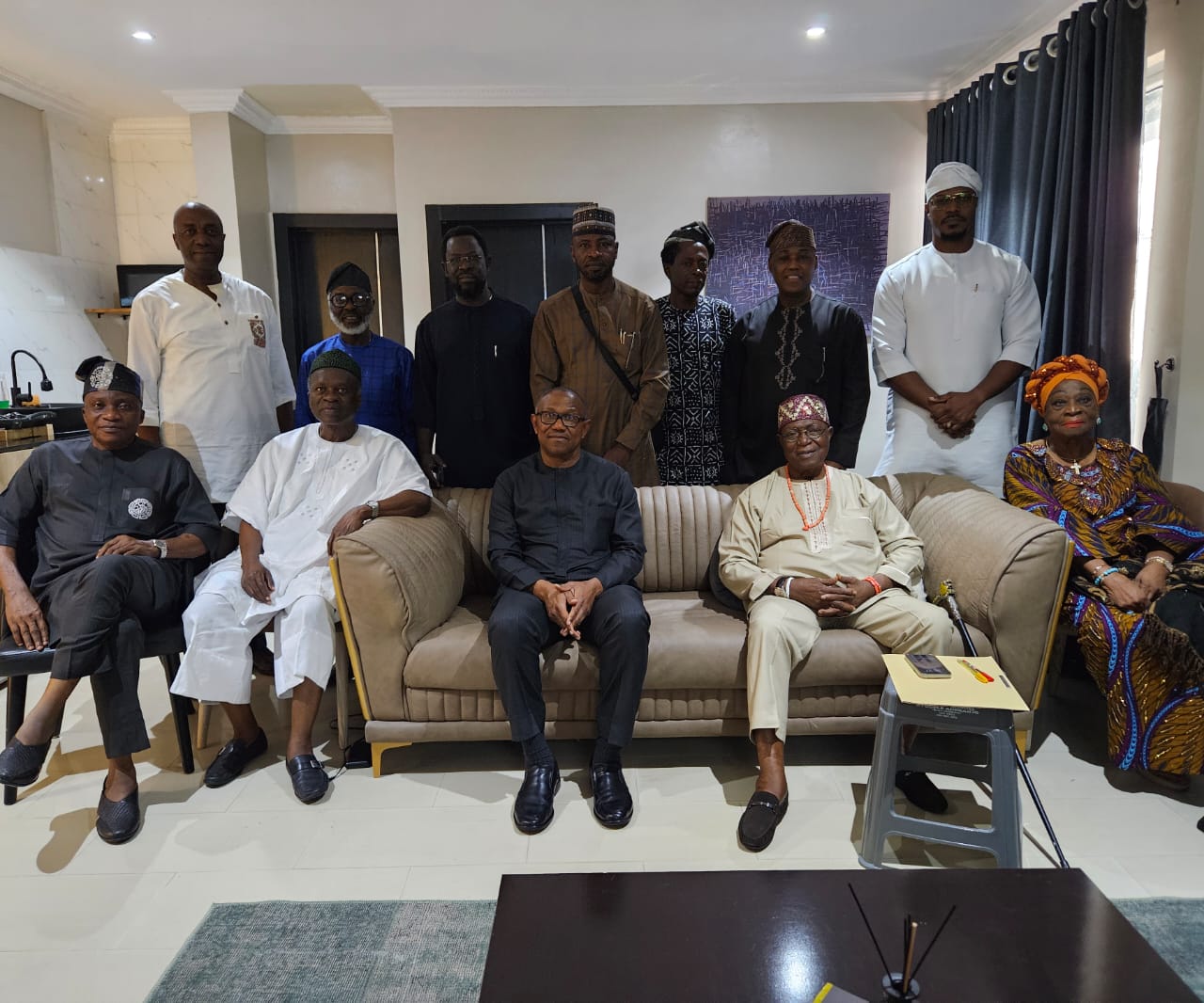
Labour Party leader and former presidential candidate, Peter Obi, has renewed his campaign for a more united and equitable Nigeria, meeting on Tuesday, September 16, 2025, with the leadership of Afenifere, the influential pan-Yoruba socio-political organisation.
The closed-door meeting, chaired by Oba Oladipo Olaitan, also the head of a coalition of ethnic nationality groups including PANDEF and the Middle Belt Forum, was convened in Abuja to discuss Nigeria’s deep-seated challenges—from education and healthcare to widespread poverty—and explore paths toward a more stable federation.
Obi praised Afenifere’s “courage and unwavering commitment to fearless justice and the unity of Nigeria,” urging the group not to relent in its decades-long advocacy for fairness and equity. “We had a useful and extensive discussion about the current state of our country, particularly in education, health, and pulling people out of poverty,” Obi told journalists afterward. “I remain committed to an all-inclusive, united Nigeria where no part will be left behind. A new Nigeria is possible.”

The meeting comes amid rising political realignments ahead of the 2027 general elections, with Obi’s ongoing consultations signaling a broader strategy to build bridges across Nigeria’s often-divided regional and political blocs.
Political observers say the engagement underscores Afenifere’s continued influence as a moral voice in Nigerian politics, even as it navigates generational transitions within its leadership. By reaching out to a group historically aligned with progressive causes, Obi is positioning himself as a candidate willing to listen, collaborate, and forge consensus beyond ethnic or partisan lines.
The discussions also reportedly touched on urgent governance concerns, including tackling the brain drain in education, improving primary healthcare systems, and implementing sustainable poverty-alleviation programs.
For Afenifere, the meeting reinforced its role as a defender of inclusivity and federal balance, while for Obi, it was another step in a deliberate effort to rally support for a vision of Nigeria where, as he often says, “no child goes to bed hungry, and no region feels abandoned.”
Analysts believe the dialogue may help shape alliances that could redefine Nigeria’s political map in the coming election cycle, sending a signal that conversations about the nation’s future must transcend old divisions and focus on shared aspirations.