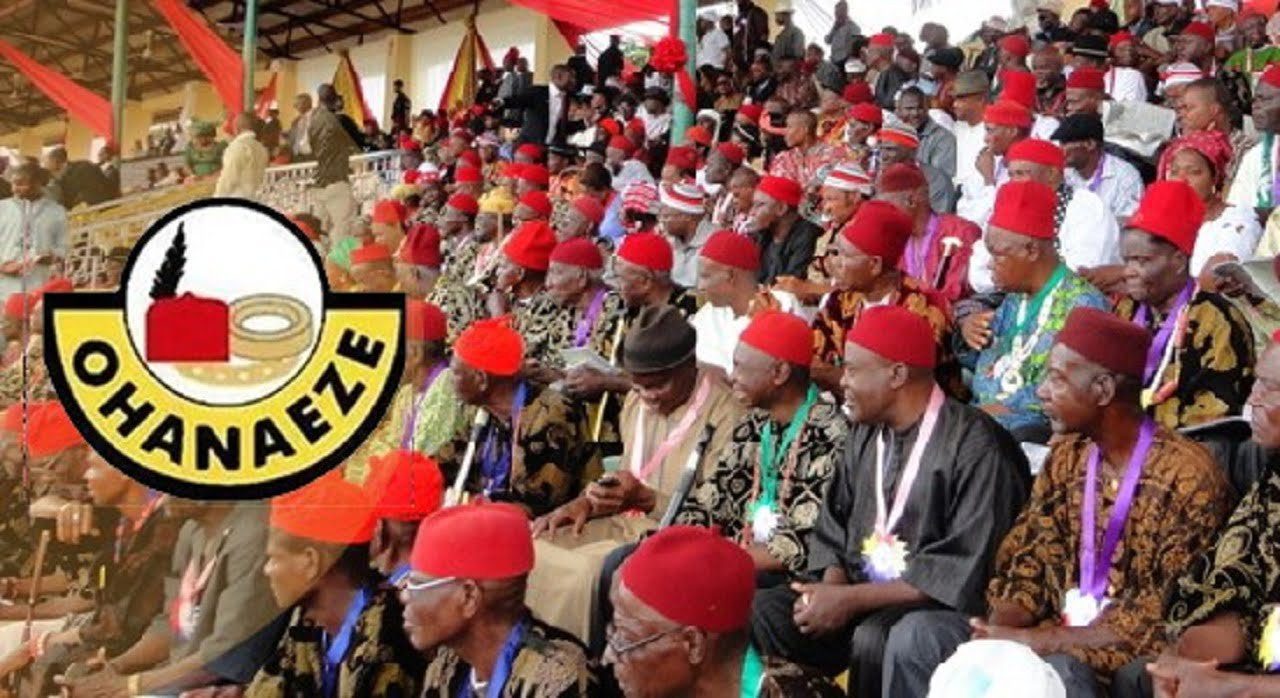
In a move that has shocked many within the Southeast, the apex Igbo sociocultural group, Ohanaeze Ndigbo, has openly declared that no candidate of Igbo extraction will challenge President Bola Ahmed Tinubu in the 2027 presidential election.
Instead of pushing forward with the long-held dream of an Igbo presidency, the group announced its total support for Tinubu’s re-election bid — effectively shelving the Southeast’s ambition until 2035.
The declaration, signed by Ohanaeze factional leaders Mazi Okechukwu Isiguzoro and Chief Thompson Ohia, followed a meeting with Southeast political stakeholders, Imeobi and Nzukoumunna.
According to the statement, Ohanaeze is prepared to deliver “about 95% of Igbo votes” to Tinubu in 2027, describing it as a “strategic sacrifice” to secure future chances.
But the move has been widely seen as the Southeast once again playing into the hands of other regions by surrendering its own best chance at power.
“Ohanaeze Ndigbo finds it paramount to convey a forthright message not only to Ndigbo but to all Nigerians: the goal of achieving an Igbo presidency is realizable only in 2035,” the group declared.
The group listed a roll call of prominent Igbo sons capable of leading the nation to include Peter Obi, Ifanyi Okowa, Pius Anyim, Hope Uzodinma, Chukwuma Soludo, Rochas Okorocha, and David Umahi.
Yet, rather than rally behind any of them, Ohanaeze narrowed on Umahi, the Minister of Works, as the “most prepared” to wear the crown but only in 2035.
The irony was not lost on observers: even with such a deep bench of tested leaders, the Southeast elite chose not to field anyone in 2027, effectively endorsing the status quo.
Critics say this posture only deepens the perception that the Igbo political class has repeatedly undermined its own people’s chances at the presidency from 1999 when the region failed to unite behind a single candidate, to 2023 when internal divisions undercut the Peter Obi wave.
Now, with 2027 looming, the region has again chosen to take the back seat, ceding the field to Tinubu.
Ohanaeze argues that aligning with the APC is the only realistic path to eventual Igbo presidency, but many see it as another chapter in the Southeast’s long-running political retreat.
Ohanaeze insists the historic opportunity will come in 2035, after power is expected to rotate back to the North in 2031. But skeptics warn that by continuously deferring its ambition, the Southeast risks missing out altogether.
For now, what should have been the rallying cry for an Igbo presidency in 2027 has instead turned into a pledge of loyalty to Tinubu, with Igbo votes promised in bulk.
Whether this strategy positions the Southeast for power in 2035 or cements its reputation for political self-sabotage remains to be seen.
2027: Ohanaeze Bows to Tinubu as Igbo Leaders Abandon Own Presidential Ambition