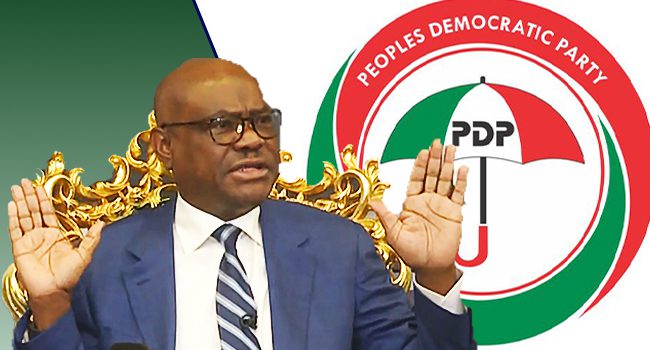
In the unfolding theatre of Nigeria’s post-election politics, one man is stealing the spotlight—not with a defection, not with fanfare, but by walking a tightrope few dare to attempt. Nyesom Wike, the firebrand former Rivers governor turned Federal Capital Territory Minister, is redrawing the map of opposition politics from within the citadel of power.
Call it contradiction or call it strategy, Wike calls it neither. He calls it loyalty—with a twist.
“I’m not Janus. I’m not two-faced,” Wike declared during a recent media chat, brushing aside comparisons to the Roman god famed for looking both ways. “I didn’t support Atiku. I didn’t defect. I stayed to fight.”
This isn’t the first time Wike has been accused of political heresy. But this time, it’s different. He is serving in an APC-led government while still waving the PDP flag, unbothered by whispers of betrayal and undeterred by fire from both sides.
Observers now speak of a new political formula — “the Wike Doctrine”: dismantle the system by being part of it. Reform the opposition by refusing to be cast out. Stay close enough to power to bend it, yet far enough to still claim rebellion.
“Wike is reinventing what it means to be opposition,” says Dr. Lydia Ebere, political historian at the University of Nigeria. “He’s moved from rabble-rouser to institutional disruptor—co-governing with power while claiming to hold it accountable.”
Inside the PDP, his presence is both unsettling and electrifying. He doesn’t whisper criticism—he roars it. He calls his party out for losing its soul, for tolerating “buccaneers and vampires,” for abandoning principle in pursuit of raw power.
“I stayed in the PDP to fight. The others ran,” he thundered. “They hop between parties for ambition, not justice.”
And when confronted with murmurs of a secret alliance between PDP and APC during Rivers’ local government elections, Wike neither confirmed nor denied—but instead dropped a grenade of political pragmatism.
“If leaders from both parties sit down and say, ‘Let’s not fight,’ is that bad?” he asked, raising eyebrows and possibilities alike.
Analysts say Wike may be piloting something new: post-partisan stabilization, a method of dampening political violence in fragile zones by blurring traditional party lines in exchange for peace and functionality.
But make no mistake—Wike is not trying to “rescue Nigeria,” as his former colleagues once promised.
“I’m trying to rebuild it from a functional centre,” he says. It’s not opposition. It’s not loyalty. It’s something in between—something more dangerous, or perhaps more visionary.
Whether the PDP embraces this experiment or casts him further into the wilderness is unclear. What is clear is that Wike is no longer playing by the old rules. He’s writing a new playbook—and everyone else, willingly or not, is being forced to read it.
Inside Wike’s Power Paradox: The PDP Strongman Turning Opposition on Its Head