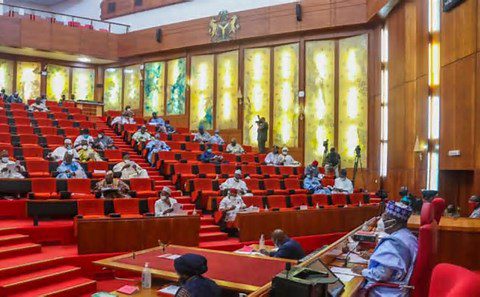

A brewing legislative rift escalated on Wednesday as members of the House of Representatives openly criticized the Senate for failing to act on 146 bills transmitted for concurrence, some of which have lingered without attention since 2024.
During plenary presided over by Speaker Tajudeen Abbas, lawmakers took the unprecedented step of stepping down two Senate-sponsored bills in protest—sending a clear signal of frustration over what they describe as legislative non-reciprocity.
The tension flared when Minority Leader Hon. Kingsley Chinda was called to second a Senate bill seeking to amend the Federal Orthopaedic Hospital Management Act to establish a new hospital in Obokun, Osun State, sponsored by Senate Leader Senator Michael Opeyemi Bamidele.

“I reluctantly support the motion for second reading,” Chinda said, lamenting that the Senate does not reciprocate the House’s legislative cooperation. “They expect us to pass their bills, but ours are ignored.”
A second bill—seeking to establish the Federal University of Medicine and Medical Sciences, Egbe, Kogi State—was also stepped down following a motion by House Leader Hon. Julius Ihonvbere.
Other lawmakers echoed Chinda’s sentiments, urging retaliation if the Senate continues to disregard bills from the House.
“I have two bills in the Senate since early 2024. They’ve not even been listed. The same thing happened in the 9th Assembly,” lamented Hon. Awaji-Inombek Abiante.
“Let’s not pretend this is working. Let us step down their bills until we understand why ours are not being treated,” he added.
Hon. Ahmed Jaba called for a formal agreement between the Rules and Business Committees of both chambers to avoid further deadlock.
“Let there be tit-for-tat. The House is not a subordinate to the Senate, and we will no longer act like one.”
Speaker Abbas confirmed the backlog, stating that 146 House bills remain pending with the Senate, including over 10 personal bills that have gone unattended for more than six months.
“This is very worrisome. We don’t know what’s happening on the other side,” Abbas remarked.
Hon. Ahmed Satome, Chairman of the House Committee on National Security and Intelligence, proposed that the House adopt a rule enforcing a specific timeline for the Senate to act on concurrence. If deadlines aren’t met, such bills should be deemed passed.
Trying to calm the heated session, Speaker Abbas urged restraint but supported the call for stronger coordination, noting that continued neglect would no longer be tolerated.
In a final twist, Chinda rescinded his earlier reluctant endorsement and formally withdrew support for the bill’s second reading.
“If given the opportunity, I withdraw my support. Let us step down the bill and demand a meeting with the Senate leadership to resolve this matter,” he declared.
The session ended with a unified call for legislative equity and a warning that unless the Senate begins to act on the House’s bills, further cooperation may be withheld.