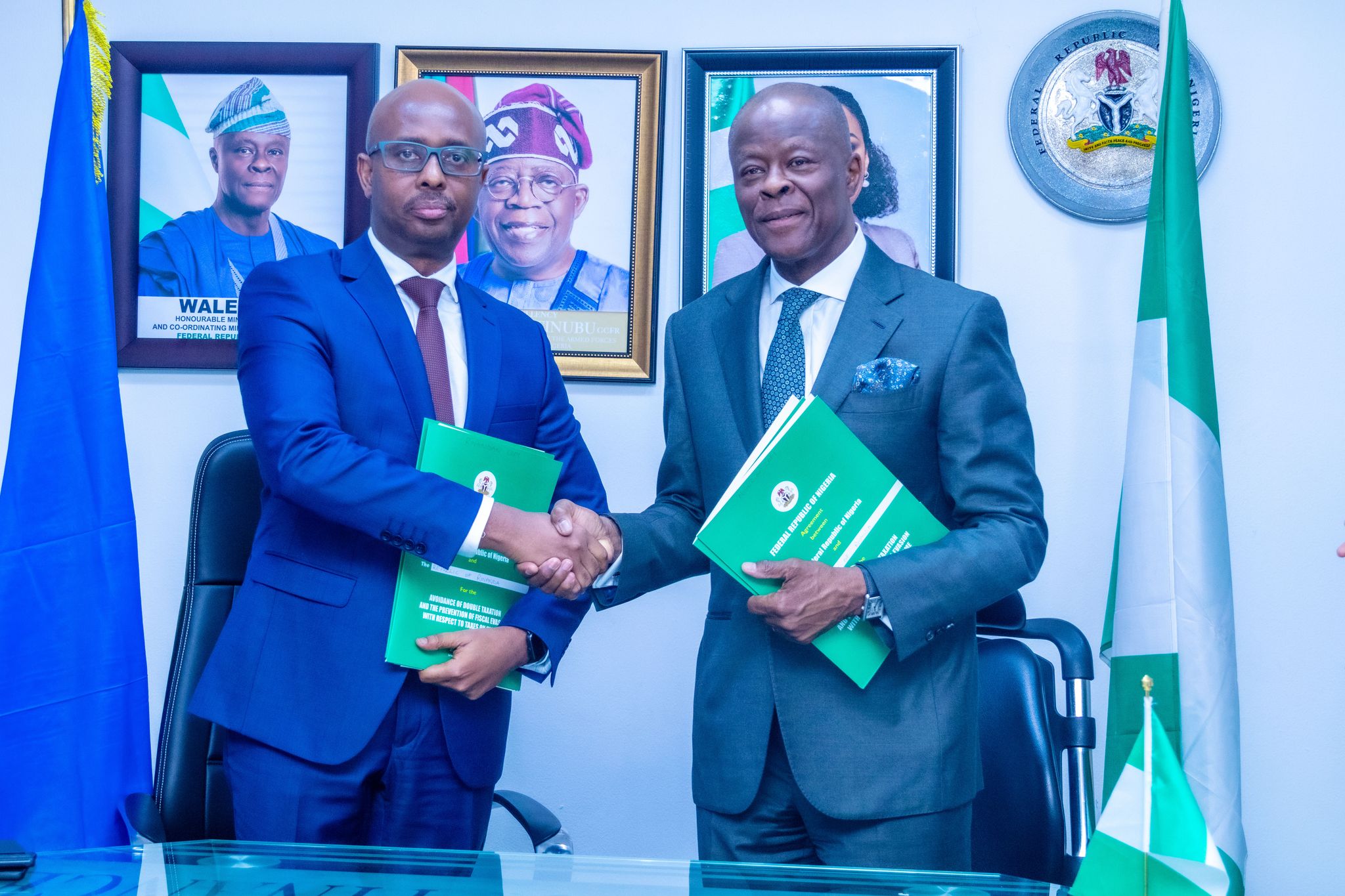
In a defining moment for African economic integration, Nigeria and Rwanda have signed a historic double taxation treaty that signals a bold step towards reclaiming the continent’s financial sovereignty and unlocking cross-border private capital.
The agreement—inked on the sidelines of the 32nd Afreximbank Annual Meetings in Abuja—is far more than a bureaucratic tax instrument. It marks the convergence of two reform-minded African economies, committed to rewriting the rules of engagement for investors and governments alike.

Signed by Nigeria’s Minister of Finance and Coordinating Minister of the Economy, Mr. Wale Edun, and Rwanda’s Minister of Finance and Economic Planning, Mr. Yusuf Murangwa, the treaty will eliminate the risk of the same income being taxed twice in both countries.
But its real value lies in what it unlocks: trust, transparency, and shared ambition.
Director of Information and Public relations, Muhammed Manga in a statement quoted Edun to have said,
“This is more than a tax agreement—it is a strategic platform for economic diplomacy, “It helps position Nigeria as a prime destination for investment within the AfCFTA framework, and encourages the kind of cross-border partnerships we need to build a resilient, self-financing Africa.”
Coming just weeks after Nigeria passed four landmark tax reform bills, the treaty reflects a new policy rhythm—a region finally tuning its instruments for the symphony of private-sector-led growth.
For Nigeria, a country with Africa’s largest economy and population, the deal sends a powerful signal to investors: tax clarity is here to stay.
Minister Murangwa echoed that sentiment, calling the agreement “a cornerstone for long-term regional integration.”
“Rwanda and Nigeria are showing what cooperation looks like in the new Africa—where we move beyond aid and towards equity, innovation, and capital flow.”
At its core, the treaty removes a critical barrier to business: uncertainty.
For African startups and multinationals alike, operating across borders often means navigating a web of conflicting tax laws, resulting in avoidable costs and compliance headaches.
With this agreement, the two nations are saying: Let’s make it easier to do business in Africa, for Africans and with Africans.

The sectors poised to benefit are among the most dynamic—technology, logistics, agribusiness, creative economy, and digital finance.
For instance, a Nigerian fintech launching operations in Kigali—or a Rwandan agri-tech firm partnering with farmers in Kano—will now have a simpler, more predictable tax environment.

This bilateral win could become continental policy. As African governments confront global economic headwinds, initiatives like this treaty showcase an emerging confidence: that African countries can set the terms, shape the frameworks, and lead the future of global trade—on their own terms.
“What we witnessed today is a quiet revolution in policy thinking,” said a senior trade analyst at the African Union. “It’s about moving from protectionism to productive partnerships, from extraction to investment.”
The technical teams behind the treaty—praised by both ministers for their expertise and foresight—crafted a framework that is globally compliant yet locally empowering. It introduces mechanisms for tax dispute resolution, information exchange, and anti-abuse provisions to prevent tax avoidance, while protecting the revenue interests of both countries.
In a world where capital is mobile and competition is fierce, treaties like this are no longer optional—they are the cornerstone of credible economic governance.
As Nigeria and Rwanda step forward, the message is clear: Africa is not waiting for permission. It is building its own investment architecture—one treaty, one reform, one partnership at a time.