


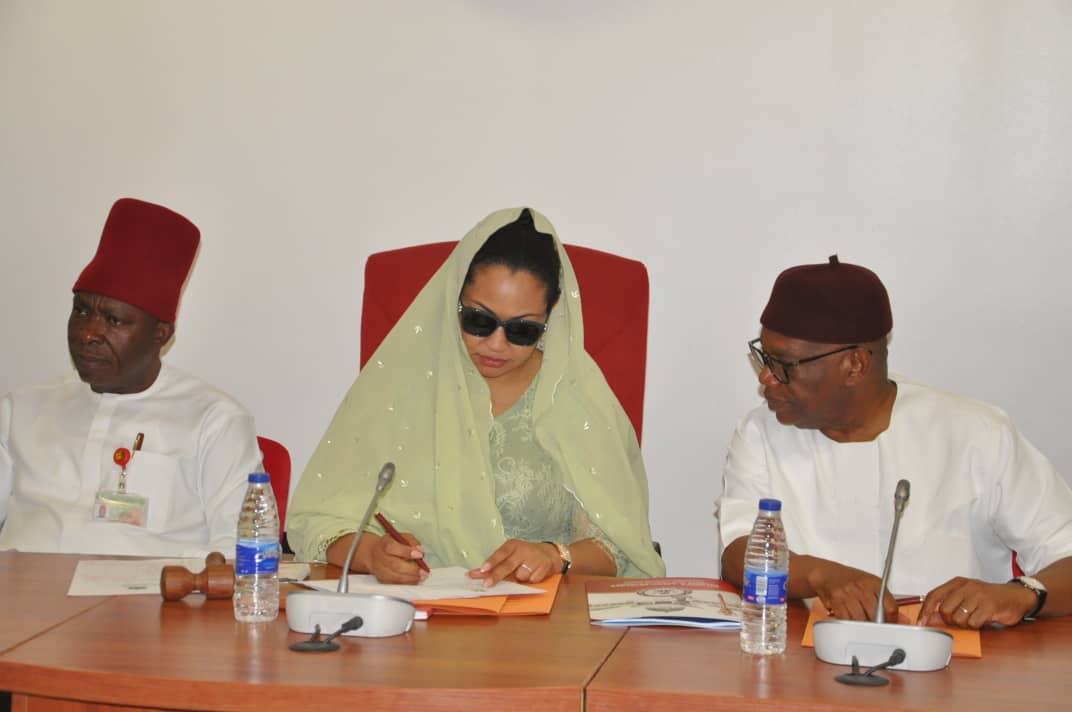
The recent suspension of Senator Natasha Akpoti-Uduaghan by the Nigerian Senate, presided over by Senator Godswill Akpabio, has raised serious questions about fairness, legality, and the integrity of the legislative body.
The events unfolded when Senator Godswill Akpabio, the accused in a petition brought by Senator Natasha Akpoti-Uduaghan, took the extraordinary step of overseeing a Senate session that resulted in her suspension.
This action, devoid of a fair hearing, not only undermines Senator Natasha Akpoti-Uduaghan’s fundamental right to be heard but also casts a shadow over the Senate’s commitment to justice and due process.
At the heart of this matter is a glaring procedural flaw: there was no fair hearing.
A fair hearing is a cornerstone of justice, ensuring that all parties are given an equal opportunity to present their case before an impartial arbiter. In this instance, Senator Natasha Akpoti-Uduaghan, the accuser, was denied that right.
Instead, the accused, Senator Godswill Akpabio, presided over the session that sealed her fate. This is a textbook violation of natural justice, which demands that no one should be a judge in their own cause.
The accused and the accuser should have been brought before a neutral and impartial panel to adjudicate the matter, ensuring transparency and fairness. Senator Godswill Akpabio’s failure to recuse himself from the proceedings reeks of bias and undermines the principle of presumed innocence, which he, as a public official, is entitled to but should not exploit to his advantage.
Former Senate President Bukola Saraki’s approach in similar situations offers a valuable lesson. Saraki, when faced with contentious issues, often emphasized the importance of stepping aside to allow for an unbiased process.
Had Senator Godswill Akpabio followed this precedent, he could have preserved the Senate’s integrity and avoided the perception of a kangaroo court. Instead, his decision to act as both judge and jury in his own case has fueled allegations of abuse of office—ironically, one of the very charges Senator Natasha Akpoti-Uduaghan leveled against him in her petition.
This twist of fate only strengthens her claims and exposes a troubling lack of self-awareness on Senator Godswill Akpabio’s part.Perhaps the most disheartening aspect of this episode is the silence of opposition lawmakers.
One would expect them to rally in defense of their colleague, Senator Natasha AkpotiUduaghan, and challenge the apparent overreach of power.
Yet, their failure to rise to the occasion suggests either apathy or a deeper systemic weakness within the Senate.
This inertia is not just a betrayal of Senator Natasha Akpoti-Uduaghan but a disservice to the democratic principles they are sworn to uphold.
The absence of a robust opposition response has allowed this miscarriage of justice to proceed unchecked, leaving many to wonder about the state of accountability in Nigeria’s upper legislative chamber.History provides a compelling backdrop to this saga.
In 2017, the Senate suspended Senator Ali Ndume for six months, only for a court to later declare the action “an exhibition of lawlessness.”
The Senate did not appeal the verdict, tacitly accepting its illegality. A year later, in 2018, under Bukola Saraki’s leadership, Senator Ovie Omo-Agege faced a 90-day suspension.
Once again, the courts intervened, ruling that the Senate lacked the authority to suspend a senator for more than 14 days and that due process and fair hearing must be respected.
These precedents establish a clear legal framework: suspensions exceeding 14 days are unconstitutional, and any disciplinary action must adhere to the principles of fairness.
Given this judicial clarity, one must ask: on what legal foundation does the Senate now justify Senator Natasha Akpoti-Uduaghan’s six-month suspension?
The duration alone exceeds the court-established limit by a wide margin, and the absence of a fair hearing further erodes its legitimacy.
Senator Godswill Akpabio’s leadership has seemingly ignored these rulings, plunging the Senate into a quagmire of illegality and reinforcing perceptions of impunity.
The irony is inescapable—by presiding over this suspension, Godswill Akpabio has arguably abused his office, lending credence to the very accusation Senator Natasha Akpoti-Uduaghan raised against him.
In a nutshell, the suspension of Senator Natasha AkpotiUduaghan represents a troubling chapter in the Nigerian Senate’s history.
It exposes a blatant disregard for due process, a failure of leadership to uphold impartiality, and a missed opportunity for the opposition to defend democratic norms.
The courts have repeatedly clarified the limits of the Senate’s disciplinary powers, yet these lessons appear unheeded.
Unless this decision is revisited and rectified, it risks setting a dangerous precedent—one where personal vendettas and unchecked authority triumph over justice and the rule of law.
The Senate must do better, not just for Senator Natasha Akpoti-Uduaghan, but for the integrity of the institution and the trust of the Nigerian people it serves.
HIGH CHIEF PETER AMEH NATIONAL SECRETARY, CUPP
Also Policy Management Strategist, 2019 Presidential Candidate, and Former National Chairman Inter-Party Advisory Council (IPAC)
