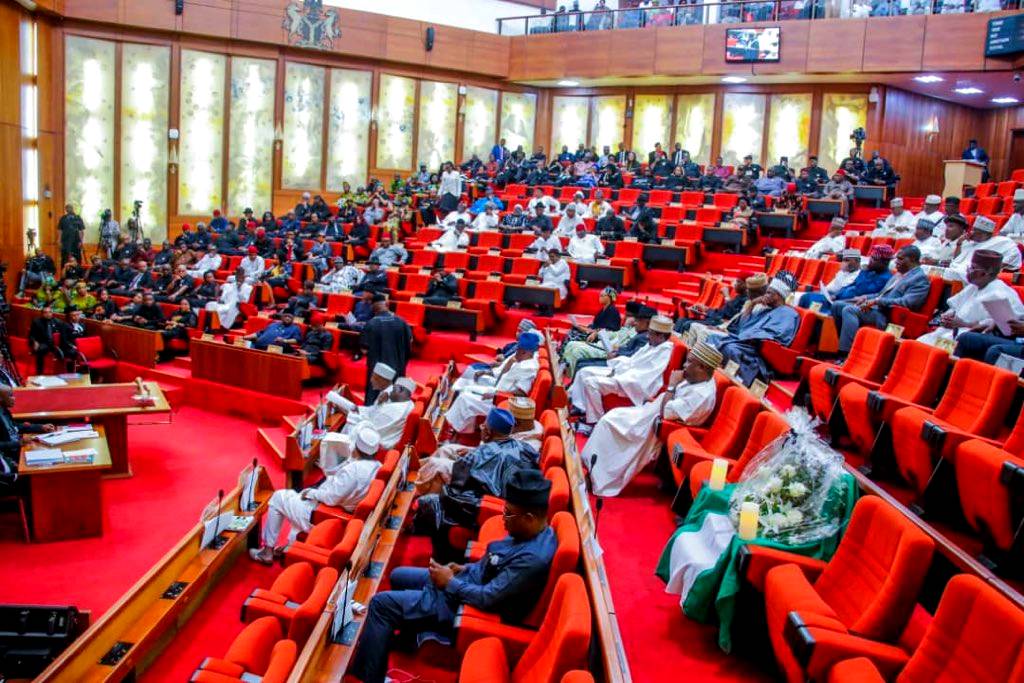

The Senate has passed for second reading a bill that will alter the Federal Inland Revenue Service (FIRS) Act to regulate the processes of granting corporate tax holidays, import duty waivers and investment incentives to investors and businesses in Nigeria.
The bill, sponsored by Yahaya Abubakar Abdullahi (PDP, Kebbi North), seeks to whittle down the powers of the federal government to unilaterally grant tax holidays and incentives to businesses.
It seeks to create a new section (9) in the FIRS Act to mandate the Service to secure due legislative approval of the National Assembly in granting of new or renewal of corporate tax incentives and waivers.
It states that for purposes of transparency, efficiency, effective monitoring and fair play, all requests and applications for parliamentary approval shall be referred to the Senate and the House of Representatives for necessary scrutiny.
“Such requests and applications for parliamentary approval shall stipulate clear conditions and justification for granting tax waivers and investment incentives.
“All, or any other enactments specific to cases of granting investment incentives and tax waivers to businesses, institutions and individuals that conflict with the provision of this Act, shall be deemed, not applicable,” he said.
Senator Abdullahi, in his lead debate, said the bill has become imperative due to leakages and loopholes in tax collection and remittances to government amid revenue shortfalls and high debt profile.
He expressed worry that in the last five years, the country has not been able to achieve its revenue targets.
Figures from the Debt Management Office (DMO) showed that N3.9 trillion was realised out of the targeted revenue of N7.2 trillion in 2018.
In 2019, the target was N7 trillion while actual revenue collected was N4.12 trillion.
The sum of N5.4 trillion revenue was targeted in 2020 but N3.9 trillion was received.
In 2021, the target was N6.4 trillion while N4.64 trillion was received.
In 2022, targeted revenue was put at N5.82 trillion while actual revenue received was N3.66 trillion.
The lawmaker expressed concern that debt service is consuming over 90% of the government’s revenues up from 32.7% in 2015.
He said, “If this trend of relentless reliance on increasing public debt to finance the budget continues without corresponding rise in revenues, the country shall slide into distress and insolvency.
“With petroleum revenues dwindling into insignificance, we must rise to rationalize the system of tax administration by blocking loopholes, and tax evasion and ensure utmost efficiency in tax management.
“It is important to note that even while government explores other means of increasing its revenue streams and improve collecting capacity, the National Assembly must act with firmness and determination to ensure that we initiate and pass laws that regulate revenue streams collection and remittance.
“In early 2020, the FIRS reported a loss of N 1.3 trillion to tax waivers, in five years. And this was in just three sectors of the economy. Similarly, in October 2021, losses were put at $2.9 billion yearly, in tax waivers to multinationals.
“It is obvious that there are several other similar cases; and all this happening in the face of government increasing difficulties to fund its various development projects and welfare commitments across the country.
“The overall intendment of this Amendment Bill, therefore, is to ensure that government is able to pool all its collectibles in one coffer, to be able to target its allocations to those areas of priority in the country.
“An effective way to do this is to re-organize the processes of granting tax holidays, investment incentives and waivers to private individuals and corporate entities for effective coordination and transparency.
“We must also ensure that such applications are placed before the National Assembly, in order to ensure that all arms of the government are on the same page on this delicate matter.”
The bill, after scaling second reading was referred to Senate Committee on Trade and Investment for further legislative works.