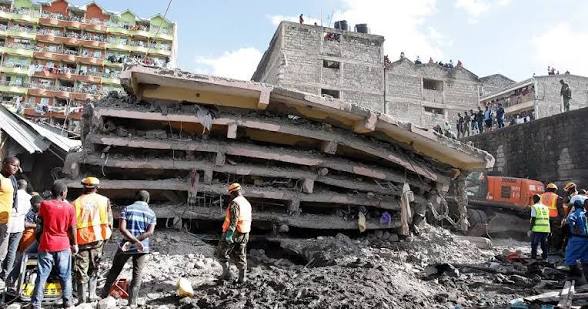
A human rights advocacy group, the Human Rights Writers Association of Nigeria (HURIWA), has condemned the recent building collapse in the Durumi area of Abuja, which reportedly killed at least five people and left several others injured or trapped under debris, describing the incident as yet another avoidable tragedy rooted in systemic failure and institutional negligence.
In a strongly worded statement issued on Saturday, HURIWA said the collapse is not an isolated occurrence but part of a disturbing pattern of structural failures in the Federal Capital Territory (FCT), which has persisted for over a decade despite repeated warnings from professionals and recurring public inquiries.
The group argued that Abuja’s growing list of building collapses reflects a deeper governance problem involving weak regulatory enforcement, corruption in approval processes, and political interference in urban planning and land administration.
According to the organisation, the Durumi incident underscores what it called a “dangerous combination of compromised engineering standards, regulatory negligence, and profit-driven construction practices” that continue to put lives at risk across the capital city.
HURIWA stated that professional bodies in the construction sector—including engineers, architects, and urban planners—have consistently identified common causes of such collapses. These include the use of substandard materials, weak concrete mixtures, structural overloading, poor soil testing, illegal structural modifications, and failure to comply with approved building specifications.
Despite these repeated findings, the group lamented that enforcement agencies in the FCT have failed to implement lasting reforms or ensure accountability within the construction sector.
The organisation further claimed that successive administrations in the FCT have allowed regulatory institutions to deteriorate, resulting in a system where building approvals are sometimes influenced by political patronage, personal connections, and financial inducements rather than strict technical compliance.
HURIWA also recalled that similar incidents have occurred in several Abuja districts over the years, including Jabi, Gwarinpa, Kubwa, Lokogoma, Lifecamp, and Guzape, noting that investigations into such disasters are often announced but rarely produce lasting reforms or visible prosecutions.
“The cycle of collapse, investigation, and silence has become a tragic norm,” the group said, warning that impunity has emboldened developers and weakened public trust in regulatory agencies.
The group criticised what it described as the gradual commercialisation of land administration in Abuja, arguing that the original masterplan of the city has been undermined by uncontrolled development and weak oversight.
It said the Federal Capital Territory, originally designed as a model city with strict planning standards, is increasingly being compromised by unregulated expansion and political allocation of land to private interests.
HURIWA also directed criticism at FCT authorities, urging the Minister, Nyesom Wike, to move beyond condolence visits and reactive interventions and instead pursue comprehensive institutional reforms aimed at preventing future disasters.
While acknowledging government efforts to support victims, including emergency response and medical assistance, the group insisted that prevention should take priority over post-disaster relief.
“It is not enough to treat survivors; the real responsibility is to ensure such tragedies do not occur in the first place,” the statement emphasised.
HURIWA called for the establishment of an independent judicial panel of inquiry to investigate building collapses in Abuja since 2015, as well as the prosecution of developers, engineers, contractors, and regulatory officials found culpable in negligence or corruption.
The group also demanded immediate structural integrity audits of ongoing construction projects across the FCT, along with full digitalisation and public access to building approval records to enhance transparency.
In addition, it urged stronger coordination among regulatory bodies such as the Council for the Regulation of Engineering in Nigeria (COREN), the Nigerian Society of Engineers (NSE), and the Nigerian Institute of Architects (NIA), alongside tougher sanctions for officials involved in approving unsafe structures.
HURIWA warned that unless urgent reforms are implemented, building collapses will continue to claim lives and undermine confidence in urban governance in Nigeria’s capital city.
The group concluded that every collapsed building represents not just a technical failure, but a breakdown of accountability and governance, insisting that the Durumi tragedy must serve as a turning point rather than another forgotten headline.
HURIWA Blames Corruption, Weak Regulation for Abuja Collapse Crisis