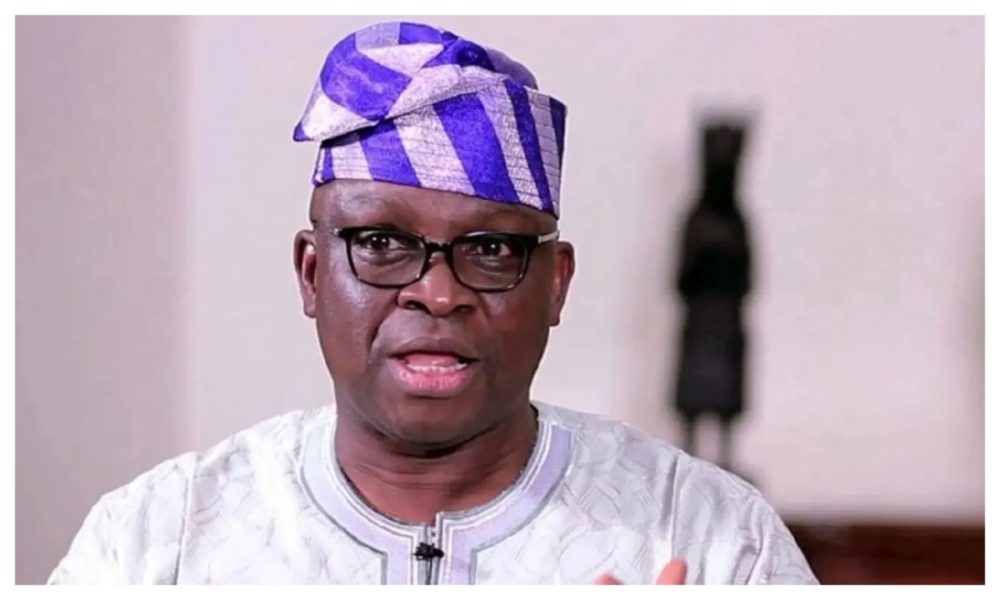
Former Ekiti State governor, Ayodele Fayose, has stirred fresh debate ahead of the 2027 general elections, warning that the African Democratic Congress (ADC) risks political irrelevance if Peter Obi does not emerge as its presidential candidate.
Fayose made the assertion on Sunday while speaking at the national convention of the Peoples Democratic Party (PDP) in Abuja, where he also weighed in on the performance of President Bola Tinubu and the shifting dynamics within Nigeria’s opposition politics.
In a blunt assessment of the ADC’s prospects, Fayose said the party’s fortunes are closely tied to Obi’s political relevance and popularity among Nigerian voters, particularly the youth demographic that powered his 2023 presidential run.
“I told you that if Obi is not on the ballot of ADC, that is the end of ADC,” Fayose declared, underscoring what he described as the party’s overreliance on a single political figure.
His comments come amid growing speculation over possible realignments ahead of the next election cycle, with reports suggesting that former Vice President Atiku Abubakar may be positioning himself to secure the ADC’s presidential ticket. Fayose appeared to lend credence to this possibility, noting that emerging signals indicate Obi may not be in contention within the party.
“It looks like now that Obi will not; Atiku will get the ticket,” he said.
Despite acknowledging Obi’s personal appeal, Fayose cast doubt on the former Anambra State governor’s chances of clinching the presidency under current political conditions. He described Obi as “a fantastic guy,” but argued that the path to the presidency remains steep and uncertain.
“It’s impossible for him to go back to the Labour Party. Obi is a good guy… but to become the president at this time is difficult,” he added.
Fayose’s remarks highlight the deepening uncertainty within Nigeria’s opposition landscape, where multiple parties and political heavyweights are jostling for influence ahead of 2027. The ADC, in particular, has recently been at the center of discussions about a possible coalition platform for opposition figures seeking to challenge the ruling establishment.
On the performance of President Tinubu, Fayose offered a mixed review, acknowledging efforts by the administration while suggesting that expectations have not been fully met.
“You don’t have to have 100 percent of any issue before you are said to be doing well,” he said. “But when you relate our past with our present, he is not doing well.”
The comments reflect a broader national conversation about governance, economic pressures, and political alternatives as Nigerians look ahead to the next election cycle.
With political alignments still fluid, Fayose’s intervention adds to mounting pressure on opposition parties to present a united and credible front. Whether the ADC can build a viable coalition without Obi—or whether new alliances will emerge—remains one of the defining questions on Nigeria’s road to 2027.
2027: Fayose Warns ADC Faces Collapse Without Obi on Presidential Ballot