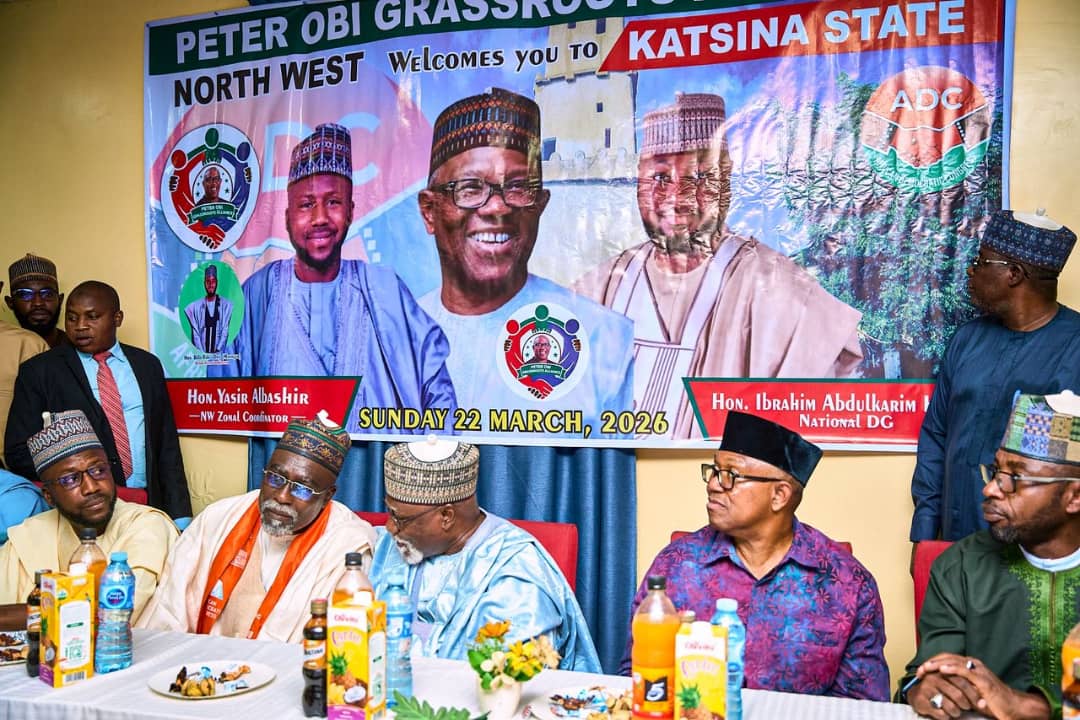
Former presidential candidate Peter Obi has taken his message of national rebirth to Northern Nigeria, weaving together calls for unity, security, and responsible leadership amid rising tensions across the country
Moving through Kaduna, Katsina, and Kano, Obi’s outreach blended political engagement with symbolic gestures of solidarity at a time many Nigerians feel increasingly uncertain about the country’s direction.
In Kano, he stood shoulder-to-shoulder with Rabiu Musa Kwankwaso and the Kwankwasiyya Movement during their Sallah gathering—an appearance that underscored a broader message: Nigeria’s divisions must give way to shared purpose.
He described Kano not just as a city, but as a living testament to what Nigeria can achieve when leadership aligns with vision and enterprise.
But it was in Katsina that the tone shifted.
Against the backdrop of fresh killings, Obi’s message turned somber, direct, and urgent.
Meeting with stakeholders including Mustapha M. Inuwa and Lawal Musa Daura, he confronted the country’s most pressing failure—its inability to protect its own people.
“A nation that cannot secure its citizens cannot move forward,” he declared, offering condolences while demanding a reset in priorities.
Threaded through his Northern tour was a familiar but sharpened argument: Nigeria must abandon politics built on tribe, religion, and entitlement.
Instead, Obi pushed for a system anchored on competence, integrity, and measurable results—warning that anything less would only deepen the country’s crisis.
“The Nigeria we seek will not happen by chance,” he stressed. “It must be built deliberately.”
Obi’s message also carried a generational undertone—placing women and young people at the center of Nigeria’s recovery.
He called for targeted investments in skills, opportunities, and inclusion, arguing that no nation can rise while sidelining its most productive population.
Though devoid of campaign theatrics, the tour signaled something deeper: a steady attempt to reshape political conversation in a country searching for direction.
His closing note was simple but pointed—less rhetoric, more responsibility.
A reminder that change will not come from noise alone, but from sustained, collective effort.
“A new Nigeria is possible.”
Obi Storms North, Rallies Unity as Insecurity Bites Harder