


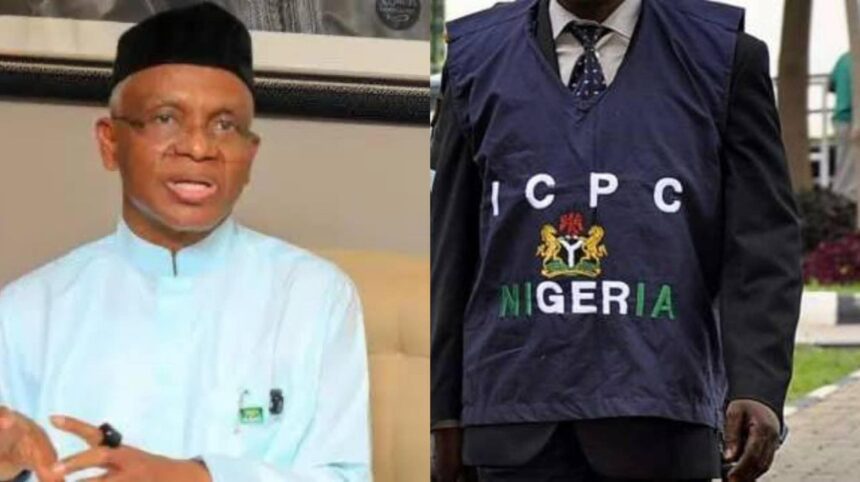
***Rights Breach Denied by Agency
A fresh controversy has erupted between the camp of former Kaduna State Governor Nasir El-Rufai and the Independent Corrupt Practices and Other Related Offences Commission (ICPC), following explosive allegations that the anti-graft agency has denied him access to medical care while in custody.
The claims, made by El-Rufai’s media adviser, Muyiwa Adekeye, have triggered a heated exchange with the ICPC, which has dismissed the allegations as “misleading,” deepening public concern over the treatment of high-profile detainees.
Adekeye alleged that the former governor has been suffering from a worsening eye condition, describing symptoms of swollen, reddish and itchy eyes, and insisting that repeated requests for medical attention were ignored by officials of the Commission.
He further claimed that despite an earlier visit to an eye clinic on June 4, El-Rufai’s condition deteriorated overnight, prompting renewed appeals from his family for urgent medical intervention—requests he said were allegedly denied.
According to him, ICPC operatives not only blocked access to doctors but also misrepresented El-Rufai’s position to his family, including claims that he had refused medical attention—an assertion the aide strongly rejected.
The media adviser also accused the Commission of disregarding a court order allegedly obtained to guarantee access to proper medical care, arguing that no agency has the right to deny a detainee healthcare while in custody.
“No government agency is permitted to be indifferent to the medical condition of a person in custody,” Adekeye said, insisting that the ICPC must comply with constitutional rights and judicial directives.
He further alleged that attempts by the former governor’s personal physician to visit him were rebuffed at the gate, with officials demanding additional authorization before allowing access.
The family of the former governor had earlier raised similar concerns, accusing the agency of restricting access to food deliveries and medical support, including turning back El-Rufai’s doctor and preventing evening visits by relatives.
Those allegations also claimed that internal directives at the facility placed strict limits on visitation and deliveries, worsening what the family described as an already “delicate medical situation.”
However, the ICPC has firmly denied all allegations, describing them as inaccurate and aimed at distorting the reality of the former governor’s detention conditions.
The Commission insists that all procedures regarding detainee welfare are in line with established protocols and legal standards, rejecting any suggestion of mistreatment or rights violations.
The clash has now escalated into a broader public debate over the treatment of high-profile suspects in custody, the limits of agency discretion, and the enforcement of court orders in sensitive investigations.
As of press time, neither the ICPC nor El-Rufai’s legal team had released further clarifications beyond their initial positions.
