


By Friday Idachaba, Lokoja
As Artificial Intelligence continues to reshape economies, institutions and everyday life across the globe, a leading Nigerian scholar has sounded a note of caution, warning that technological advancement must never come at the expense of human dignity.
A Professor of Ethics and Values, Nicholas Ojoajogwu Okpe, has called on governments, technology companies, scientists and policymakers to place the sanctity of the human person at the center of the rapidly expanding AI ecosystem.
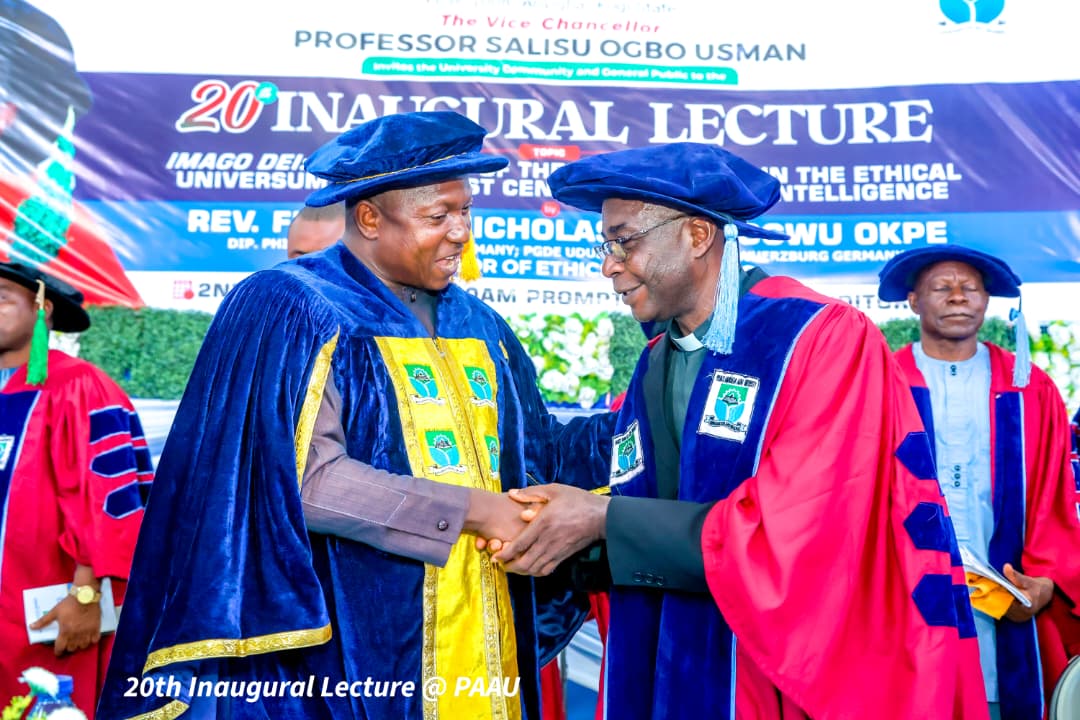
Speaking at the 20th Inaugural Lecture of Prince Abubakar Audu University, the cleric-scholar argued that humanity is approaching a defining moment where machines are becoming increasingly capable of performing tasks once considered exclusively human, raising profound ethical questions about identity, responsibility and the future of civilization.
Delivering a lecture titled “Imago Dei: The Dignity of the Human Being in the Ethical Universum of 21st Century Artificial Intelligence,” Prof. Okpe maintained that while AI holds enormous potential for innovation and progress, its development must be governed by ethical principles that protect human worth and freedom.
He noted that technological revolutions have historically transformed societies and altered human understanding of the world, but described the emergence of Artificial Intelligence as one of the most consequential developments of the modern era.
According to him, the concept of Imago Dei—the belief that every human being is created in the image and likeness of God—provides a moral foundation for evaluating the impact of intelligent technologies on society.
He stressed that human value cannot be measured solely by productivity, efficiency, computational ability or economic output, insisting that every person possesses inherent dignity that technology must respect and preserve.
“Any conversation about Artificial Intelligence must begin with a conversation about what it means to be human,” he argued.
The ethics scholar warned that the race to develop increasingly sophisticated AI systems could create unintended consequences if ethical safeguards are ignored.
He identified growing concerns such as mass surveillance, invasion of privacy, algorithmic discrimination, economic displacement, erosion of personal autonomy and the gradual blurring of boundaries between humans and machines as some of the risks requiring urgent attention.
Prof. Okpe further argued that despite advances in machine learning and automation, no artificial system can replicate the human conscience, which he described as the ultimate moral compass guiding decisions about right and wrong.
Tracing the evolution of AI from Information AI to Agentic AI, Physical AI and the emerging concept of Conscious AI, he said humanity must remain vigilant to ensure that technological capabilities do not outpace ethical responsibility.
The professor called for comprehensive governance frameworks built on transparency, accountability, justice, human rights and the common good, warning that societies that fail to establish ethical guardrails could face significant social and moral consequences.
He urged governments, universities, technology developers and international institutions to work collaboratively in creating policies that guarantee AI remains a tool for human flourishing rather than a force that diminishes human agency.
Earlier, Chairman of the Inaugural Lecture Committee, Sunday Salifu Arogba, congratulated the lecturer on the academic milestone and commended his contributions to scholarship.
In his remarks, the Vice-Chancellor of the university, Salisu Ogbo Usman, described the lecture as timely and thought-provoking, noting that Artificial Intelligence has emerged as one of the most transformative technologies of the century with far-reaching implications for education, healthcare, governance, security, business and scientific advancement.
He said the lecture underscored the critical role of universities in shaping public discourse on emerging global challenges and reaffirmed the institution’s commitment to providing intellectual leadership on issues affecting humanity’s future.
